Cuckoos
Common Cuckoo
Link copied.
Cuculus canorus
Link copied.
Voice
Song
Song
Song
How to recognize it
-
32–34 cm long, slender build
-
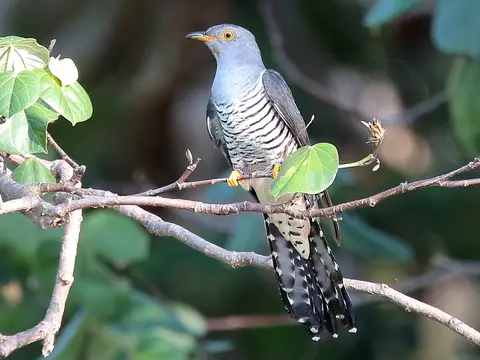
Adult male: grey upperparts and throat, white belly with dark bars
-
In flight — long pointed wings, long wedge-shaped tail, bars on belly and underwings
-
In spring and early summer, male repeats a measured "cuck-oo... cuck-oo" from an open perch
About the species
Most adults are grey above, with a pale underside crossed by dark bars. In males, the grey throat ends sharply above the barring. When perched, they often let their wings droop and lift the long tail. Some females are rusty brown above, while young cuckoos may show a white patch on the nape.
In spring, males call from open perches with a measured “goo-ko, goo-ko”; females give a bubbling trill. Outside the breeding season, cuckoos are mostly quiet and secretive. A female lays an egg in another species’ nest, and her chick may push the host’s eggs or young out of the nest.
Woodland, scrub, and open country with scattered trees all suit it, so it is not confined to dense forest. It eats mainly insects, especially hairy caterpillars. It spends the warmer months across Europe and Asia, then migrates south to winter in Africa.
Where to find
-
During the breeding season in light, open woodland, listen for the Common Cuckoo's measured "cuck-oo" song from an exposed perch.
-
In open forest-steppe with scattered trees or shrubs, scan exposed perches for a calling silhouette with drooped wings and a raised tail.
-
During the breeding season in Central Asian reedbeds, listen for the female's ringing, bubbling trill, usually given in flight.