Swifts
Common Swift
Link copied.
Apus apus
Link copied.
Voice
Call
Song
Call
How to recognize it
-
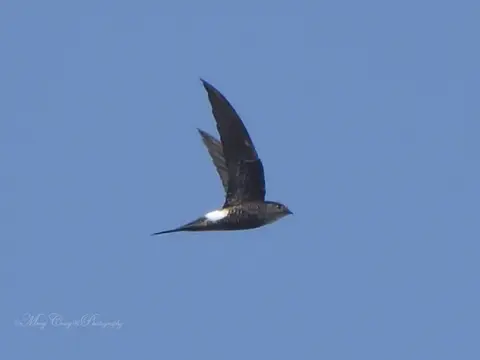
18 cm, starling-sized
-
Dark brown, almost uniform below
-
Very long sickle-shaped wings, short forked tail
-
Loud shrill scream, often in flying groups
About the species
The common swift spends most of its life on the wing, with long swept-back wings and a deep, fast flight. It gives a loud screaming call, often in groups on summer evenings, and rarely settles except to cling to vertical surfaces.
It feeds, drinks, and even sleeps while flying. Young stay in the nest for a long time before leaving, and pairs often return to the same nesting place and partner year after year.
In towns it uses gaps under roofs, wall holes, tree cavities, and cliffs for nesting. It takes insects in flight and migrates to Africa for the winter, returning in spring.
Did you know?
-
Eats, sleeps, mates aloft
The Common Swift is so completely committed to flight that it eats, sleeps and even mates on the wing, returning to a solid surface only to lay its eggs.
Link copied.
-
A year on the wing
After leaving the nest in August, a young Common Swift stays airborne for a year or more — only touching down again when it slips into a cavity as a future breeder.
Link copied.
-
160 km/h, 900 km a day
The Common Swift hits 160 km/h in flight and can cover up to 900 km in a single day — an endurance few birds can match.
Link copied.
Where to find
-
In old city blocks and courtyards with tall buildings — at dusk, when loud screaming carries from eaves and roof gaps and dark shapes cut quick circles overhead.
-
Along canal banks, riverfronts, and pond edges in warm weather — Common Swift hunts insects low over the water in fast, sweeping turns.
-
Near bridges, towers, and old stone buildings — especially where narrow cracks under the roof let them shoot out and vanish again.
-
Early in summer above open squares and wide courtyards — look for small screaming flocks wheeling around nesting sites.