Shrikes · Perching birds
Great Gray Shrike
Link copied.
Lanius excubitor
Link copied.
How to recognize it
-
Body length 22–26 cm
-
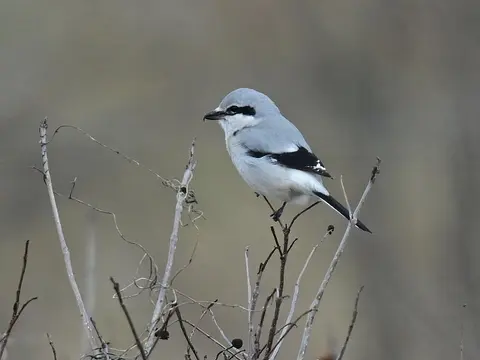
Ash-gray back, white underparts, black mask through the eye
-
Black wings with a white patch; long black tail with white edges
-
Upright posture, frequent tail twitches; undulating flight
About the species
Look for a pearly-gray back above pale underparts, with a broad black mask running from the bill past the eye. White patches on the shoulders and wings break up the dark feathers, while the long black tail has white edges. The chest can be slightly grayer than the belly, and the hooked bill gives the face a sharp outline.
It watches from the top of a tree, post, or other exposed perch, then drops onto prey below; it may also hover while scanning open ground. Its song includes short phrases such as "tu-tu-krr-pree-pree," mixed with whistles, and a harsh "kweee" alarm call. It stores surplus prey by impaling it on thorns or barbed wire, and may mimic other species’ calls to draw them within reach.
Open grassland with scattered shrubs and nearby trees suits it, as do bogs, clearings, and less intensively farmed fields. Rodents make up much of its food, alongside insects and other small animals. Many populations move short distances south in winter when prey becomes scarce, while some stay year-round in milder areas.
Where to find
-
On open grassland beyond the city, where isolated trees rise among scattered shrubs, look for the Great Gray Shrike on an upper branch: it scans for prey and may briefly hover almost in place above the grass.
-
In steppe, check isolated poles, wires, and rocks — from these high perches it sits upright and scans for prey.
-
On thorny shrubs or barbed wire in open country, look for impaled prey — it stores food this way for later.