Nuthatches · Perching birds
Krüper's Nuthatch
Link copied.
Sitta krueperi
Link copied.
How to recognize it
-
12.5 cm long
-
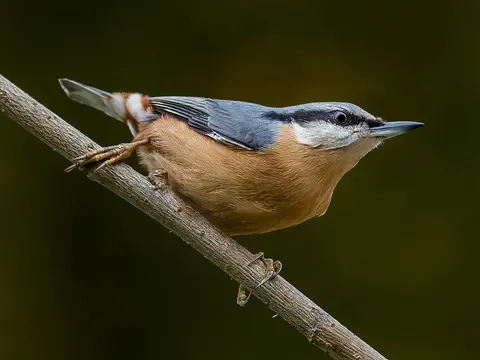
Adults: blue-grey back, white eyebrow and black front crown; crown less sharply defined in females
-
Large crescent-shaped rufous breast patch against pale underparts
-
Sharp nasal song, repeated "tuti-tuti" notes
About the species
Blue-grey above and pale underneath, Krüper’s Nuthatch has a black cap over the front of its head and a crisp white stripe above the eye. A rusty, crescent-shaped patch marks the chest, with rufous tones also showing beneath the tail. Females have buffier underparts and a less sharply defined cap than males.
It searches among fine branches high in tree crowns, but also checks bushes and occasionally feeds on the ground. Its contact call is a repeated 'dui-dui-dui'; when agitated, it gives a rough 'eehch' or a dry 'puik.' In autumn, it may join small groups, wedging pine seeds into bark cracks and hammering them open, while also storing food for later.
It lives in conifer forests in Turkey, the western Caucasus and on the Greek island of Lesbos, especially where Turkish pine grows. In summer it feeds mainly on insects, switching to pine and other conifer seeds in autumn and winter. It is mostly resident, though some move to lower forests in winter.
Where to find
-
In conifer forests in Turkey, the Caucasus and Lesbos, look among the fine branches near the crowns of large trees as Krüper's Nuthatch searches for food.
-
During autumn and winter in the same forests, watch for pine and other conifer seeds being wedged into bark crevices and hammered open.
-
During nesting — mid-March to mid-May in Turkey and April–May in the Caucasus — look high in conifers for visits to tree holes with food for the chicks.