Loons
Arctic Loon
Link copied.
Gavia arctica
Link copied.
How to recognize it
-
58–73 cm long
-
Breeding plumage: ash-gray head and neck, black throat and front of neck with white streaks; white squares on the back
-
Nonbreeding adult: white sides of head and front of neck, dark cap and hindneck; mostly plain back
-
Fast, straight flight with legs trailing; takes off from water after a long run-up
About the species
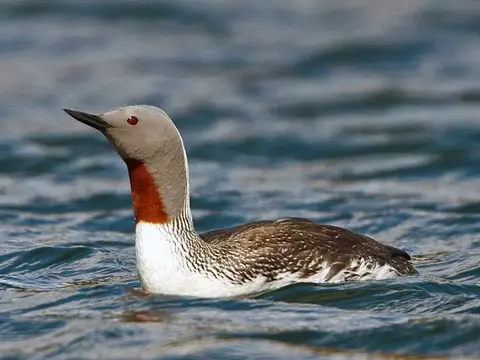
On a breeding lake, the Arctic Loon has a grey head and neck above a black throat and dark back, with a clean white underside. Rows of white squares mark the shoulders, and fine white stripes cross the lower throat; in winter, the black patch disappears and the back becomes much plainer. Its first plumage has a softer brown cast.
On the water, it may sink until only its head, neck, and a narrow strip of back remain above the surface. It catches fish underwater, usually alone or with a partner, and needs a long run across the water to take off. In breeding season, its calls include a repeated "ku-ku-ee" over the water and loud, rhythmic whistles; it grows quiet on migration and wintering grounds.
It breeds on freshwater lakes across northern Europe and Asia, usually close to the shore, then moves south to sheltered, ice-free coasts. Fish make up most of its food, though it also takes aquatic insects, molluscs, crustaceans, and occasionally plant matter.
Where to find
-
At large freshwater lakes in the northern breeding range, listen across the water in spring and summer for loud, wavering calls; on the tundra, they are especially often heard in the evening and later at night.
-
On lakes and rivers during migration, watch the surface for a neck stretching upright, followed by a slight upward jump before a dive for fish.
-
In winter, scan sheltered, ice-free sea coasts for solitary silhouettes or pairs repeatedly diving for fish.