Loons
Red-throated Loon
Link copied.
Gavia stellata
Link copied.
Voice
Call
Call
Song
How to recognize it
-
Length 53–69 cm
-
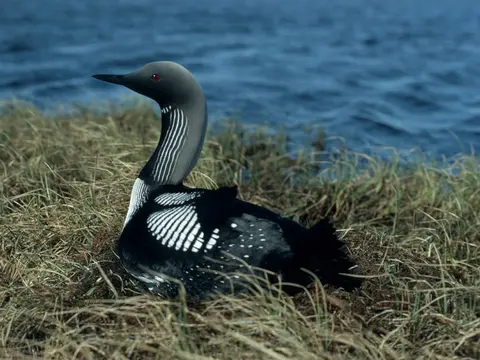
Adult in breeding plumage: reddish throat patch, grey head and neck, white belly
-
In winter, grey head and back with fine white speckles; white lower face, front of neck, chest and belly
-
In flight, neck extended forward and bowed down; quick, deep wingbeats
About the species
On winter water, the Red-throated Loon is grey above and white below, with a pale face and fine white speckles across its back. In breeding plumage, a deep reddish patch appears on the front of its throat, against a grey head and neck striped black and white behind. Its narrow bill often tilts slightly upward, and its red eye shows at close range.
It slips underwater after fish, using its feet to steer and propel itself; when alarmed, it may sink until only its head shows. Calls include rhythmic "kaa-kaa-kaa" cackles and a low, wavering wail, sometimes given by a pair together. On land it moves awkwardly, but unlike other loons it can take off directly from the ground.
It breeds on small lakes across Arctic regions, often making daily trips to larger lakes, rivers, or the sea to feed. Small fish are its main food, caught underwater, though it also takes frogs and aquatic invertebrates. In winter it leaves inland breeding waters for northern coasts, where it may gather in loose groups.
Where to find
-
In winter along northern coasts, watch for the Red-throated Loon diving beneath the surface to catch fish.
-
During migration and winter, scan feeding areas on large lakes, rivers and reservoirs, where groups may gather.
-
During the breeding season in northern tundra, especially at night, listen for a territorial pair calling from the water on a very small lake; the nest is usually right at the water's edge.