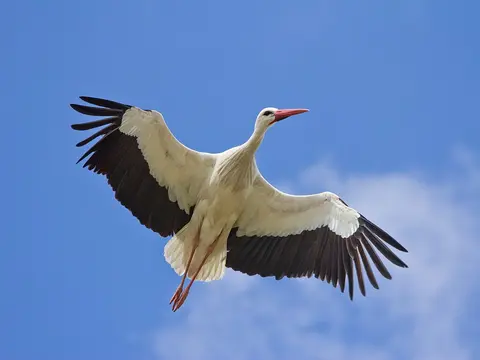
Storks
Black Stork
Link copied.
Ciconia nigra
Link copied.
How to recognize it
-
Body length 95–100 cm
-
Adults: black plumage, white underside, red bill and legs
-
In flight, neck extended and legs trailing; broad wings used for soaring
-
Rare loud flight call: "chee-leee"
About the species
In sunlight, the glossy black upper plumage picks up a green-purple sheen, while white shows across the breast, belly and beneath the tail. Long red legs and a pointed red bill stand out against the dark plumage, with bare red skin around the eyes. Juveniles are browner and less glossy.
Wary of people, it is usually alone or in pairs and gives a loud, breathy "chee-leee" call. It hisses when warning or threatened. Adults rarely clatter their bills when meeting at the nest.
It keeps to wooded wetlands, rivers and lake edges, nesting in large trees or on rocky ledges. In shallow water, it wades slowly after fish, amphibians and insects. European populations migrate to tropical Africa for winter, while Asian populations winter in the Indian subcontinent; a separate population in southern Africa stays year-round.
Where to find
-
Outside town, beside forest lakes and quiet rivers, look in the shallows for a black stork wading slowly as it hunts fish and other prey.
-
In natural areas near water where livestock graze or deer feed, watch for it staying close to the larger animals and catching small creatures and invertebrates they flush.
-
During the breeding season, in dense forest far from homes, scan above the nest territory for pairs soaring together and calling to each other early or late in the day — dense canopy can make these flights hard to see.