Storks
White Stork
Link copied.
Ciconia ciconia
Link copied.
Voice
Song
Call
Song
How to recognize it
-
100–115 cm long
-
White plumage, black flight feathers; adults with long red legs and a straight red bill
-
Soars with neck stretched forward and legs extending beyond the short tail
-
Walks slowly and steadily on the ground
About the species
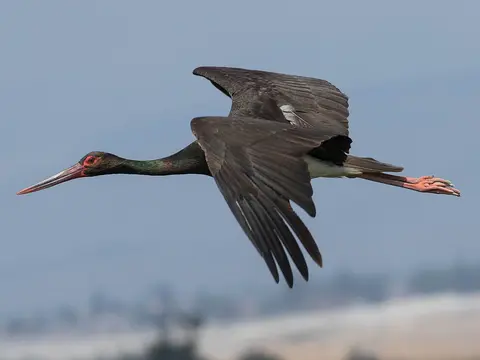
Against its white body, the black flight feathers show clearly when the wings spread, while long red legs trail behind in flight. A straight red bill points forward from its long neck, and shaggy white feathers hang over the breast. At rest, it may tuck its head between its shoulders.
Adults are mostly quiet, but when a pair meets they throw their heads back and rattle their bills in a rapid "clack-clack." On the ground, it walks slowly until prey appears, then rushes forward to seize it; overhead, it rides rising warm air with slow, regular wingbeats. Pairs may use the same large stick nest for years, often on buildings or purpose-built platforms.
Across much of Europe, White Storks feed in open meadows, farmland and shallow wetlands, taking insects and earthworms alongside frogs, small mammals and other animals. Many leave for Africa in August or September and return in spring, while some winter in India. Their long journeys stay mostly over land, where rising warm air lets them soar instead of crossing the Mediterranean.
Where to find
-
During the breeding season, look on roofs and tall poles in settlements for a large White Stork nest; the pair may greet one another there with loud bill-clattering.
-
On open lowland meadows with short grass beyond the city edge, watch for a slow walk that may turn into a sudden dash after prey.
-
At shallow marsh edges, look for foraging in the water and among low vegetation.