Owls
Boreal Owl
Link copied.
Aegolius funereus
Link copied.
Voice
Song
Song
Song
How to recognize it
-
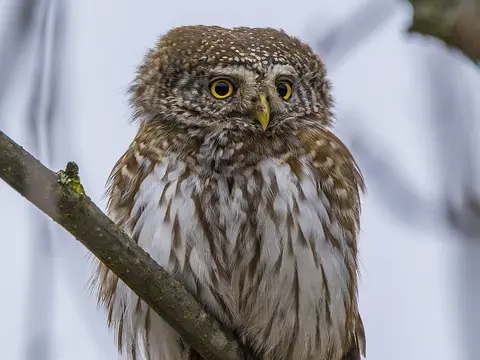
21–27 cm long, smaller than a pigeon
-
Adults: brown upperparts with white spots on back and wings
-
Pale underparts with light brown streaks; yellow eyes, pale facial disc with a dark border
-
Straight, nearly silent flight
About the species
Brown above and cream-white below, it has rusty streaks across its chest and rows of white spots on its wings and back. Its pale, round face is edged in dark feathers, with bright yellow eyes against the brown crown. Thick feathers run down its legs to the claws.
Mostly active after dark, it waits on a perch, listening for prey, then drops when it is close; its flight is quiet and direct. In spring, males repeat a low, rolling "oo-poo-poo" trill from a tree perch, sometimes for hours. They also stash captured voles in tree holes for later.
It lives in dense boreal and subalpine forests, as well as mixed woodland, and nests in tree cavities, often ones made by woodpeckers. Voles and mice are its main food, with shrews and other small mammals also taken. Many stay in the same area year-round, though northern populations may move south when deep snow or scarce prey makes hunting difficult.
Where to find
-
In coniferous or mixed woodland by lakes and moss bogs from March to April, listen for the Boreal Owl's repeated trill — the male sings from a tree near a hollow.
-
After dark in woodland, scan branches about three to four metres above ground for a still silhouette watching for prey from a low perch.
-
At the end of June in woodland, listen for adults' hoarse whistles and the rasping begging calls of fledglings moving with their parents.