Hawks and eagles
Cinereous Vulture
Link copied.
Aegypius monachus
Link copied.
Voice
Call
Call
How to recognize it
-
Body length 98–120 cm
-
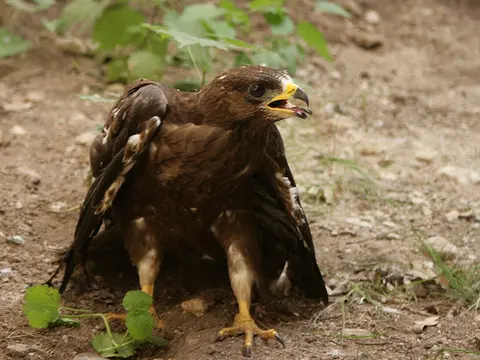
Adults have a dark brown body and wings, with a pale down-covered head
-
Very broad wings held straight or slightly arched; slow buoyant soaring, with deep heavy flaps when needed
-
Immatures are sepia-brown above, with a much paler underside than adults
About the species
From a distance, the Cinereous Vulture can look almost black, but adults are dark brown with a pale, downy head. Blue-grey skin shows around the face, and fine feathers form a loose ruff at the throat. Its huge blue-grey bill stands out against the pale head, while broad wings stretch nearly straight in flight, with only a slight arch.
Usually alone or in pairs, it circles on broad wings with slow, buoyant strokes, adding deep, heavy flaps when needed. It is mostly quiet, though adults and young may exchange rough mews, roars, or guttural calls at the nest. At a carcass, its powerful bill can tear through tough hide, and it holds its ground against other scavengers.
It ranges over remote hills and mountains, searching for carcasses across open woodland, grassland, and dry high-country meadows. Carrion makes up most of its food, from large mammals to fish and reptiles. Most stay in the same region year-round, but hard winters can prompt local movements, and some of the northernmost populations move south.
Where to find
-
Over high-altitude meadows and steppe in remote mountains, watch for a broad-winged, slow glide as it searches for carrion.
-
During the breeding season, in large mountain forests near the treeline, watch pairs make synchronized display flights above nesting areas.
-
At a large carcass in remote mountain country, a Cinereous Vulture may keep other scavengers at bay while feeding.