Hawks and eagles
European Honey-buzzard
Link copied.
Pernis apivorus
Link copied.
Voice
Call
How to recognize it
-
Body length — 52–60 cm
-
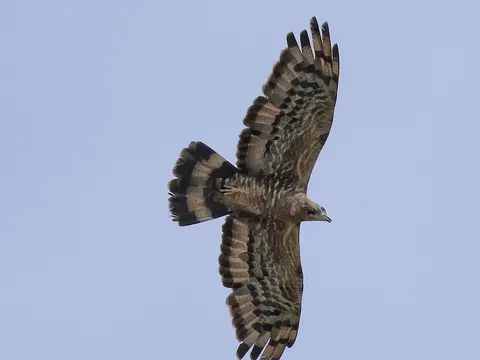
Soaring with wings held straight; tips horizontal or slightly lowered
-
Adult with a dark brown back; underside from brown to pale, with crossbars
About the species
Dark brown above, the European Honey-buzzard can be pale or brown underneath, with dark bars or streaks that vary from one individual to another. Adult males have a blue-grey head, while females are brown-headed and usually darker overall. A long, dark-banded tail and narrow wings are clear features when it glides overhead.
Over woodland it usually flies low, then may rise on flat wings to circle in warm air. Its clear call is a drawn-out "peee-lu"; among branches, it hops from perch to perch, clapping its wings once with each hop. On the ground, it digs into wasp and hornet nests for larvae, using its long toes and claws.
It breeds in woodland across much of Europe and western Asia, and spends the European winter in tropical Africa. Wasps and hornets make up most of its food, though it also takes small mammals and reptiles.
Where to find
-
In spring woodland, listen for the European honey-buzzard's loud wing-claps during its courtship display.
-
Among trees, watch for low flights that end with a perch halfway up the canopy.
-
On the forest floor, look for digging in search of larvae in wasp nests.
-
Above woodland, look up for occasional soaring in thermals.