Hawks and eagles
Common Buzzard
Link copied.
Buteo buteo
Link copied.
Voice
Call
Alarm
Call
How to recognize it
-
Body length 40–58 cm
-
Plumage varies widely, from pale buff to dark brown
-
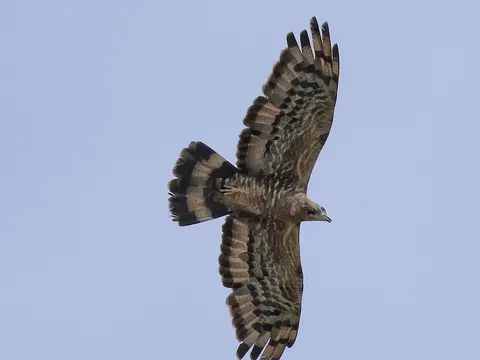
Pale patches on the wings seen from below; circles overhead for long periods
-
Long, nasal, cat-like mewing call
About the species
Over an open patch, a Common Buzzard may circle on broad wings. Its coloring ranges from pale cream to deep brown, though many are dark above with a streaked, lighter chest. A pale U-shaped band crosses the breast on some, while the short tail often shows a broad dark band near its tip.
It can circle for long stretches, then perch on a treetop, pole, or fence post to hunt, dropping onto prey below. Its far-carrying call is a plaintive "pee-yow"; near a nest, sharper yelps warn of an approach.
Woodland edges beside fields and grassland suit it, and it also turns up around suburban parks and large gardens, especially near farms. Rodents—particularly voles—make up much of its food, though it takes other small mammals and varied prey. Many populations stay year-round, while those from colder or eastern breeding areas move south for winter.
Where to find
-
At a suburban park near a farm, where trees meet open fields, a common buzzard may perch high in a tree and watch for prey.
-
Over open moorland with scattered trees, look for a silhouette soaring for a long stretch as it searches for prey.
-
Along a rocky coast, scan the ledges for a still silhouette watching for prey from a perch.