Flycatchers and chats · Perching birds
Common Nightingale
Link copied.
Luscinia megarhynchos
Link copied.
Voice
Song
Song
Alarm
How to recognize it
-
About 16.5 cm long
-
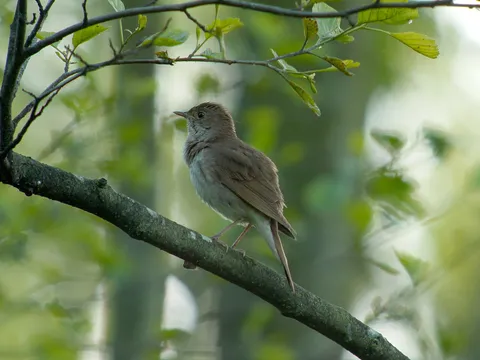
Warm brown above, greyish-buff below, tail with a reddish tinge
-
Loud song with whistles, trills and gurgling notes
About the species
Warm brown above and gray-buff below, the Common Nightingale has a reddish tail that adds its strongest flash of color. Its chest is plain, unlike the gray-brown spotted chest of the Thrush Nightingale where their ranges overlap. The sexes look alike, and yellowish-pink legs complete its muted coloring.
Males sing by day and after dark, but only unpaired males regularly sing through the night. The song runs through loud whistles, trills and gurgling notes, often rising to a clear whistle; an alarm call sounds like a frog. Nests sit on or close to the ground, tucked into dense vegetation.
Look for it in dense scrub, damp places and woodland edges. It feeds mainly on insects and other small invertebrates, turning to berries in summer and autumn. It breeds in Europe and across parts of Asia, then migrates to sub-Saharan Africa for winter.
Where to find
-
In or near a city, listen for the Common Nightingale's loud song — males raise their volume to cut through background noise.
-
At forest edges after dark, listen for song: males sing by night as well as by day, and their voices stand out especially at night.
-
In dense scrub during the nesting season, stay out of the thicket: nests may be on the ground or at a bush's edge.