Flycatchers and chats · Perching birds
Thrush Nightingale
Link copied.
Luscinia luscinia
Link copied.
Voice
Song
Song
Song
How to recognize it
-
About 16 cm long
-
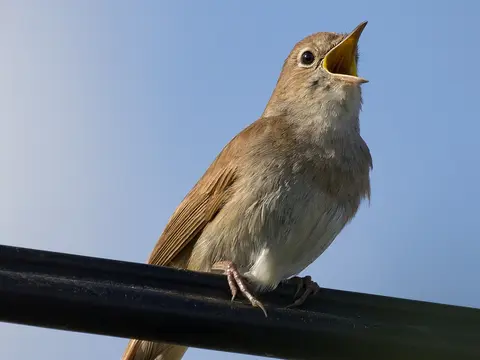
Dark brown, olive-tinged upperparts; greyish-brown, mottled breast
-
Dark rufous-brown tail, without obvious rufous patches on the sides
About the species
Dark brown above, it looks paler underneath, where grey feathers cloud the breast. Its head and back carry a faint olive cast, while the pale throat is speckled with brown and the tail is a deeper reddish brown. Unlike the Common Nightingale, it lacks obvious rusty patches at the sides of the tail.
The male's song combines whistles, trills and clicks, often with a clear, bell-toned "pioo"; a rough "dserr" may break in. Its short call is a higher, abrupt "whit." It may jerk its tail and dip in a quick bow, and some males sing even on their African wintering grounds.
It breeds in damp woodland, where dense shrubs and tangled growth often crowd the ground near water. The nest is on the ground, sometimes among nettles, and it feeds chiefly on earthworms, spiders and insects, adding berries in autumn. After breeding in Europe and western Asia, it migrates to Africa south of the Sahara.
Did you know?
-
Two hundred stylized phrases
The thrush nightingale's repertoire rivals the common nightingale's in size—up to 200 distinct phrase types—but unlike its western relative, each phrase type follows a consistent, stylized structure that is repeated rather than improvised upon.
Link copied.
-
The phrase ends with a characteristic rattle
The thrush nightingale organizes its song around rhythm rather than melody, and every phrase ends with a brief percussive tambourine-like rattle that acts as a consistent structural close across the entire repertoire.
Link copied.
Where to find
-
In May, in the floodplains of large rivers and on river islands in central European Russia and western Siberia, listen for males singing among waterside thickets.
-
In damp deciduous woods with alder and birch, look on the ground for the Thrush Nightingale searching for worms, spiders and insects.
-
In autumn, watch for berry-feeding among currant and elder bushes.