Larks · Perching birds
Eurasian Skylark
Link copied.
Alauda arvensis
Link copied.
Voice
Call
Alarm
Call
How to recognize it
-
Slightly larger than a sparrow
-
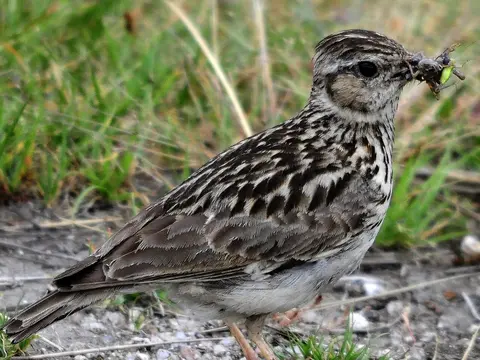
Grey-brown, streaked upperparts and breast; pale underside
-
Small crest; white edges on tail and wings visible in flight away from the observer
-
Male: long, clear bubbling song during high hovering flight
About the species
Grey-brown streaks cover its back and breast, set off by a buff-white belly. A small crest can lift and settle on its head, while a pale eyebrow runs above the dark eye. In flight, white edges on the tail and rear wings flash against the brown plumage. Males and females share the same coloring.
The male climbs high, circles, or hovers while singing. His clear, bubbling warble can continue for several minutes, and later in the breeding season it may run on for 20 minutes or more. From the ground, the singer may be little more than a speck in the sky.
It lives in open farmland, heath, grassland, and steppe, walking over the ground to find seeds, young leaves, and insects. Insects matter most in summer. Western populations are mostly resident, while eastern populations move south for winter; in milder western areas, some also shift to lowlands or the coast.
Where to find
-
During the breeding season, in open fields beyond the city edge, listen for the Eurasian Skylark's long, clear song — the male sings while hovering 50–100 metres overhead.
-
In open meadows, watch for slow steps over the ground while it searches for seeds and insects.
-
After the grain harvest, watch stubble fields for small flocks feeding on spilled grain.