Larks · Perching birds
Wood Lark
Link copied.
Lullula arborea
Link copied.
Voice
Call
Song
Call
How to recognize it
-
Length 13.5–15 cm
-
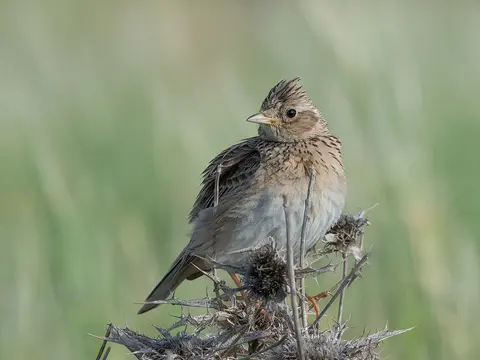
Brown back with dark streaks, pale underside
-
Pale eyebrow meeting on the nape, small inconspicuous crest
-
Warbling "lu-lu-lu" song during circling flight
About the species
Brown above and pale beneath, the Wood Lark has dark streaks along its back and a small crest that is often hard to see. Its pale eyebrows meet at the nape, while the breast is mostly plain, with brown spots along the sides. The short tail has white tips, and its wings look broad and short in flight.
A repeated "lu-lu-lu" runs through its clear, lilting song, which it may sing from a perch or the ground. Males also flutter upward in a circling song flight, keeping roughly the same height as they sing. It often settles in trees, unlike many larks.
Open heath, sparse grassland with scattered trees, and clearings in pine woods are its usual settings; it also uses newly planted pine areas. Seeds make up most of its diet, with beetles, flies, and moths added during breeding. In western parts of its range it mostly stays year-round, while eastern populations move south for winter.
Where to find
-
On heathland and open ground with scattered trees, listen for the wood lark's song flight — a male spirals upward and sings at a fairly steady height.
-
In clearings in pine forest, listen for song from the ground or a perch — both sexes sing this way.
-
During the breeding season in open, sparsely treed areas, watch for adults carrying food to chicks in a ground nest.