Kinglets · Perching birds
Goldcrest
Link copied.
Regulus regulus
Link copied.
Voice
Call
Song
Call
How to recognize it
-
9–10 cm long
-
Greenish-olive above, grayish below, two white wingbars
-
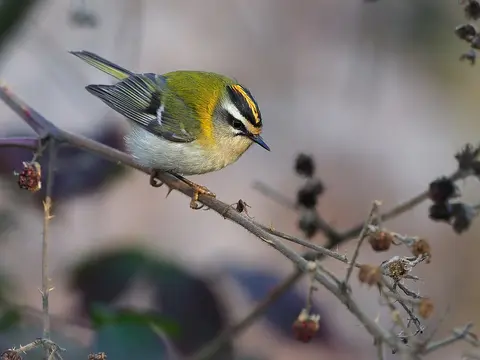
Yellow, black-edged crown stripe; wider and orange-tinged in males, lemon-yellow in females; juveniles lack it until their first autumn
-
Restless flitting in the upper canopy; thin, very high call "tsee-tsee-tsee"
About the species
Greenish olive above and pale underneath, the goldcrest has a plain face with dark eyes and two white bars across each wing. A narrow yellow stripe runs over its crown, edged in black; males have an orange center to the stripe. When alert, it lifts those crown feathers into a small crest.
It keeps moving through the foliage, creeping along branches and sometimes hanging upside down as it searches for tiny insects and spiders. Its contact call is a thin, high “zee,” repeated at intervals. Males also sing a brief run of high notes while foraging.
It breeds in conifer woods, especially among spruce and fir, and also uses parks and gardens where suitable conifers grow. Small insects, spiders and caterpillars make up much of its food, picked from the undersides of branches and leaves. In the north, some leave their breeding grounds for winter farther south, while many populations remain year-round.
Where to find
-
In city parks with few suitable conifers nearby, look into spruce or fir crowns for the Goldcrest, moving along branches and searching their undersides.
-
In conifer woodland, listen for a thin, high call from the upper canopy, then watch for quick flits and movement up and down trunks.
-
In winter, in deciduous woods and shrub thickets, scan mixed flocks of tits for tiny shapes working through the foliage.