Herons · Pelicans and herons
Little Bittern
Link copied.
Botaurus minutus
Link copied.
How to recognize it
-
Body length 33–38 cm
-
Male: black, green-sheened back and wings, pale oval wing patch
-
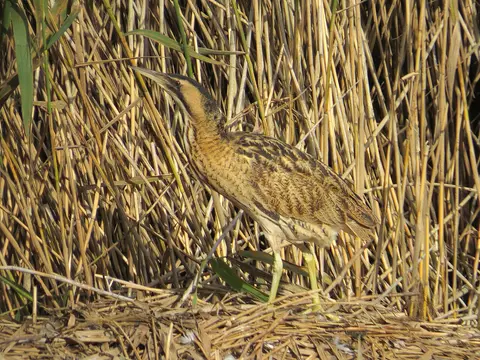
Female: streaked brown upperparts, ochre underparts, head and neck
-
Secretive among reeds; in spring, male gives a deep "krro"
About the species
At the edge of a reedbed, the Little Bittern’s coloring can look dark above and pale below. The male has a green sheen on his black crown and back, and a warm buff oval on the wing; the female is browner, with streaked underparts and a fainter patch. Both have a long, pointed bill.
Usually alone and most active at dusk, it moves slowly through reed stems, gripping them with long toes as it searches for prey. The male gives a deep, repeated “krr-o” bark in spring. It flies reluctantly, low over reeds or water, and usually only a short distance.
It keeps to still-water wetlands thick with reeds and rushes, where it catches small fish, frogs, tadpoles, and insects. In Europe, it arrives from Africa in spring and heads back in August or September; tropical populations stay year-round.
Where to find
-
From mid-April through late summer at European breeding wetlands, watch at dusk for slow stalking along the edge of dense reeds beside still water.
-
In spring, listen at dusk by reedbeds over water for the male's low, repeated croaking call.
-
Along still-water shores thick with reeds, look for movement up the stems: the Little Bittern climbs by gripping them with its long toes.