Owls
Long-eared Owl
Link copied.
Asio otus
Link copied.
Voice
Call
Alarm
Call
How to recognize it
-
About pigeon-sized
-
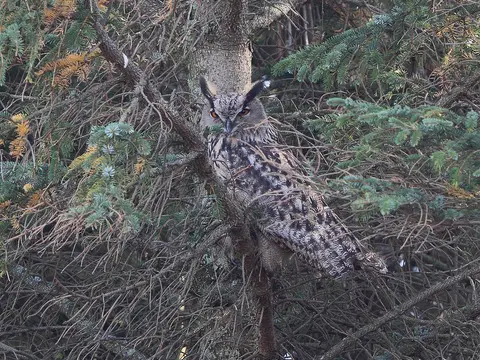
Long feather tufts set near the center of the head
-
Gray-brown plumage with mottled markings; pale breast
-
Four to six dark crossbars on the underparts
About the species
At rest, its plumage is tawny brown with a gray wash, finely marked with dark streaks across the back and wings. A pale facial disc frames orange-yellow eyes, and two long, dark feather tufts rise from the crown. The breast is lighter, with dark bars extending down the belly. Pale feathers along the shoulders make a broken line across the folded wing.
After dusk, it flies low over open ground, listening for small mammals before dropping quickly onto them. The male gives a deep, spaced-out "whoop"; both sexes also make a rough, catlike "jaiow" call. By day it roosts close to a trunk in dense foliage, and several may share a winter roost.
It uses woodland edges, hedgerows, small groves, and wooded parks, roosting in thick cover and hunting over nearby open ground. Voles and other small rodents make up most of its food. Northern populations move south in autumn, while others may wander rather than follow a fixed seasonal route.
Where to find
-
In winter, scan dense conifers in quiet city parks by day; Long-eared Owls may gather there to roost.
-
After dark, watch woodland edges and tree belts for a low, slow flight over open grass as it hunts small rodents.
-
In a city park on a calm spring evening, listen at dusk for a deep whoop repeated every few seconds from a mid-height branch or near the canopy.