Cuckoos
Oriental Cuckoo
Link copied.
Cuculus optatus
Link copied.
How to recognize it
-
30–32 cm long
-
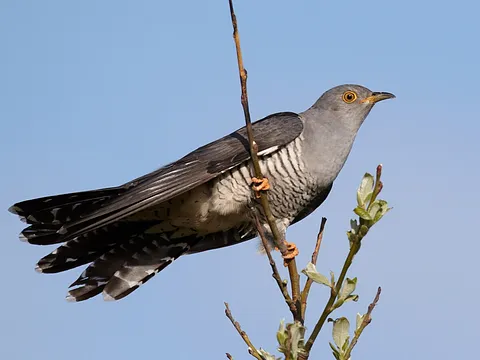
Adult male: grey head, breast and upperparts; creamy-white belly with dark bars
-
Females and juveniles occur in grey or rufous morphs; rufous morphs are dark-barred all over, including the rump
-
Male's low, repeated paired "poo-poo" notes; usually silent outside the breeding season
About the species
An adult male is grey over the head, chest and back, with a creamy-white belly crossed by dark bars. A bare yellow ring circles each eye, and its legs are orange-yellow. Females and juveniles may be grey with a brownish wash on the chest, or rusty brown above with dark bars across the paler underside.
Usually secretive, it stays among trees and bushes and sometimes forages on the ground. The male gives low, evenly stressed pairs of notes—"poo-poo"—while the female makes a deep bubbling trill; outside the breeding season, it is usually quiet. It lays eggs in the nests of other species, and its hatchling soon pushes out the host's eggs or young.
It breeds in forests across northern Eurasia, in coniferous, deciduous and mixed woodland, and feeds mainly on insects and their larvae. In southern Russia it arrives on breeding grounds around late April, then migrates south for winter, reaching areas from Southeast Asia through Indonesia to Australia.
Where to find
-
Beyond town, during the breeding season in forests from the Urals across Siberia to the Far East, listen for the male's low paired notes; outside that season, such calls are usually absent.
-
Among the trees and bushes of dense coniferous taiga, the Oriental Cuckoo searches for insects and larvae — scan the branches and thickets.
-
On the forest floor, it also forages for insects and larvae — look down as well as up.