Hawks and eagles
Steppe Eagle
Link copied.
Aquila nipalensis
Link copied.
How to recognize it
-
60–89 cm long; bulky silhouette
-
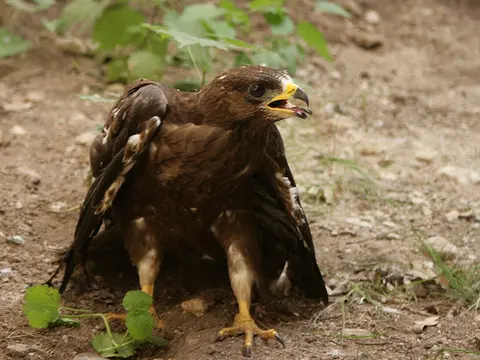
Adults dark brown, often with a rusty nape patch
-
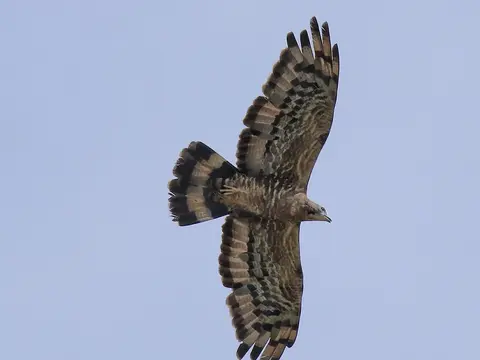
In flight, slow deep wingbeats and broad, nearly square-ended wings
-
Juveniles with broad white wing bars and a large pale patch on the inner primaries
About the species
Adults are mostly dark brown, sometimes with a rusty patch on the back of the head. Deep-set eyes sit above a long, heavy bill, and feathers cover the legs down to the yellow feet. Young eagles are paler, with broad white edges on the wings and tail that show clearly in flight.
On the ground, it may stand for long stretches, then walk with its body held nearly horizontal. In the air, slow, deep wingbeats give way to long glides. It is usually quiet outside the breeding season; its main call is a raspy bark, and away from nesting grounds several may gather at feeding sites.
It breeds in dry, open steppe, where ground squirrels and other small mammals make up much of its prey. After breeding, it migrates to winter in parts of the Middle East, Africa and South Asia, using grasslands and wetlands as well as rubbish dumps. There it may feed on insects and carrion, and large numbers pass through a few major migration routes.
Where to find
-
During the breeding season on the dry steppe plains of southern Russia, the Steppe Eagle glides low and drops toward ground squirrels.
-
On passage at mountain ridges along Middle Eastern migration routes, watch broad wings circle in rising air with few wingbeats.
-
In winter, watch from a distance for groups feeding on carrion and other easy food at large landfills and livestock carcass dumps in Arabia and India.