Owls
Ural Owl
Link copied.
Strix uralensis
Link copied.
Voice
Song
Alarm
Call
How to recognize it
-
50–64 cm long
-
Long wedge-shaped tail with dark bars, projecting well beyond folded wings
-
Pale, rounded facial disc; no ear tufts
-
Pale whitish or ochre underparts with dark lengthwise streaks, no crossbars
About the species
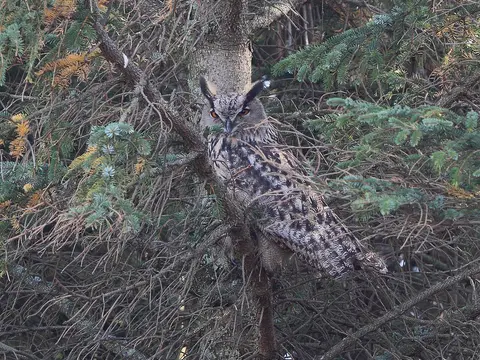
Pale grey-brown above and cream to whitish below, the Ural Owl has a round, pale face and dark streaks running down its breast. Its long tail ends in a wedge, with white tips that show in flight. Where it shares woodland with the Tawny Owl, it is larger and longer-tailed, with straight streaks below rather than the Tawny Owl’s streaks crossed by bars.
It hunts from a perch, dropping onto prey rather than chasing it through the air. A male’s deep, rhythmic "huow-huow-huow" carries through the woods; females give a rougher, slightly higher call. Mostly active around dusk and before dawn, it may hunt by day in warmer months, especially while feeding young.
Look for it in mature conifer, mixed, or deciduous forests, usually near a clearing or other open patch. Voles and other small mammals make up most of its food, though it also takes frogs and insects at times. Adults usually stay in the same territory year-round, while young owls may wander and some populations shift in severe winters.
Where to find
-
In suitable wooded parks and gardens in some Russian cities, scan dense foliage close to trunks by day — Ural Owls often roost there when food is plentiful.
-
At a glade or meadow beside mature forest around dusk, watch prominent perches: brief flights between them may end in a direct drop onto prey.
-
In forests in Finland and Scandinavia, keep your distance from nest boxes in spring — adults defending their young may swoop close and attack.