Tits · Perching birds
Willow Tit
Link copied.
Poecile montanus
Link copied.
Voice
Song
How to recognize it
-
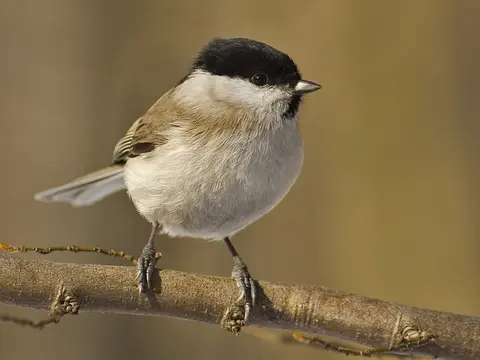
Smaller than a sparrow
-
Matte black cap reaching well down onto the back
-
Black throat patch, whitish cheeks, grey-brown back and off-white underparts
-
Frequent high call, repeated nasal "zee-zee", often followed by a rough "jeh"
About the species
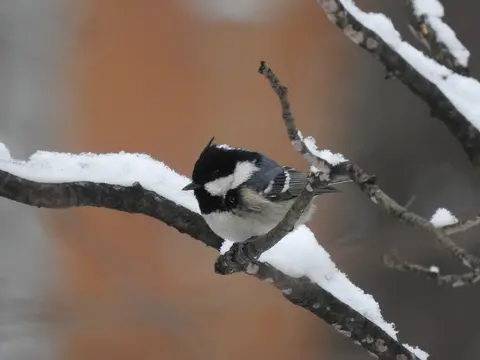
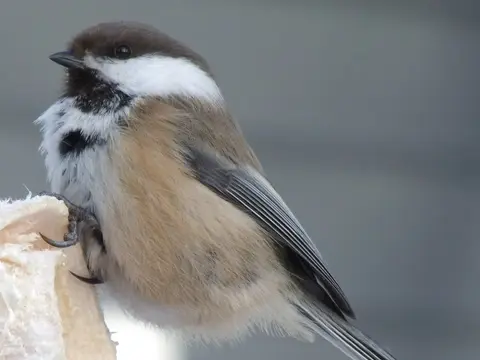
The Willow Tit has a grey-brown back and soft off-white underparts, with pale cheeks framing a matte black cap that runs down onto the upper back. A broad black bib sits beneath the bill, and pale buff edges on the folded wing form a light patch. Its sides are warm buff with a slight russet tone.
It moves through the middle and lower branches, sometimes hanging head-down from a thin twig. Its common call is a nasal "zee, zee, zee", while its song can be a slow series of even whistles. It hollows out its own nest hole in rotten wood, sometimes piercing hard bark, and hides seeds in bark crevices for later.
Coniferous and mixed woods are its main home, including river valleys and wooded edges, and it is less often found near homes than many tits. It eats insects and caterpillars as well as seeds and fruit, relying more on conifer seeds in winter. Most stay in the same area year-round rather than migrating.
Where to find
-
In coniferous or mixed woodland, away from homes, look at thin branches in the lower canopy: the Willow Tit often feeds while hanging upside down.
-
In floodplain woodland among shrubs, scan the understory as it searches for small invertebrates and their larvae.
-
In winter, in coniferous woodland, watch it check sheltered spots on trunks and among the needles for dormant insects.