Auks · Shorebirds
Common Murre
Link copied.
Uria aalge
Link copied.
Voice
Call
How to recognize it
-
38–46 cm long
-
In summer, dark head, back and wings, white underparts
-
In winter, white chin and area behind the eyes
-
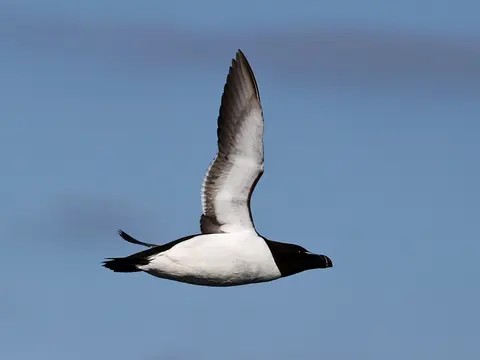
Fast, direct flight with rapid wingbeats, low over the sea
About the species
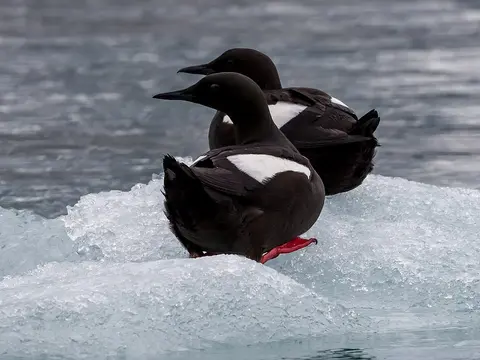
In breeding plumage, its head, back and wings are dark brown to black, set against clean white underparts. The slim, pointed bill is dark, and a small rounded tail shows behind it; in winter, white spreads across the face, leaving a dark mark behind the eye. Some North Atlantic individuals also have a white ring around the eye that trails back in a line.
At crowded cliff colonies, neighbors nest close together on bare ledges, and each pair keeps its single egg on the rock rather than building a nest. At sea, it drives itself underwater with its wings to chase fish, then flies fast and low over the surface. Colony calls rise into a rough, growling "murrrr", often loud where many gather.
It spends most of its life at sea, returning to rocky islands and cliffs to breed. Small schooling fish make up most of its food, and it often carries one in its bill with the tail hanging out. Some populations stay near their breeding grounds through winter, while those farther north move south to open water.
Where to find
-
On rocky Atlantic coasts from May to July, listen for the Common Murre's rough, growling calls from crowded cliff ledges.
-
Over open water, watch for groups flying in a line just above the sea with rapid wingbeats.
-
In winter, scan open water from shore for dark silhouettes resting afloat.