Auks · Shorebirds
Little Auk
Link copied.
Alle alle
Link copied.
How to recognize it
-
Body length 19–21 cm
-
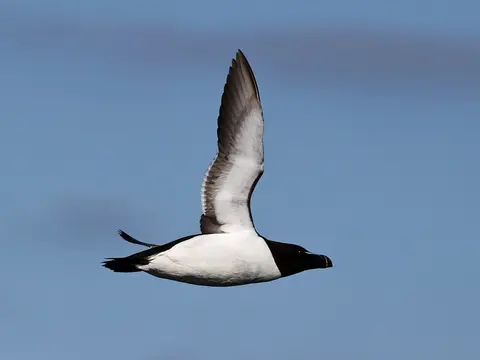
Adult in breeding plumage: black head, neck, back and wings; white belly
-
Fast, direct flight with rapid beats of short wings
About the species
Black across the head, neck, back and wings, the Little Auk has a bright white underside and a small, rounded black tail. A white line along the rear edge of each wing and pale fringes on the shoulder feathers break up the dark plumage. In winter, white extends over the lower face and front of the neck.
At its breeding colonies, it makes busy twitters and cackling calls, but is usually silent at sea. Its short wings beat rapidly in fast, direct flight; underwater, it swims after prey. Before hunting, individuals gather in large flocks.
It nests in crevices among rocks on Arctic sea cliffs, often in huge colonies. Crustaceans, especially tiny copepods, make up most of its food, with small mollusks and fish also taken; it feeds close to shore in summer and near ice edges or coasts in winter. As winter comes, it moves south across the North Atlantic, with some reaching as far as the North Sea.
Where to find
-
On scree slopes of Arctic sea cliffs during the breeding season, listen for chatter and cackling in little auk colonies.
-
Near the Arctic shoreline during the breeding season, watch for feeding dives — they forage close to shore at this time.
-
In winter, at ice edges and along coastlines, watch for dives in search of food.