Auks · Shorebirds
Razorbill
Link copied.
Alca torda
Link copied.
How to recognize it
-
38–43 cm long
-
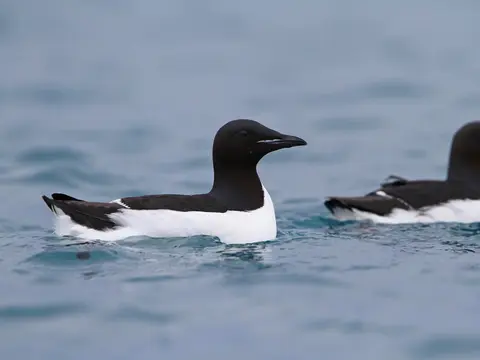
Black head and back, white belly and undersides of wings
-
In breeding plumage, a thin white line from eye to tip of the thick black bill
-
In winter, throat and part of face behind eye turn white; white line less prominent
About the species
At the water’s edge, the razorbill is black over its head, neck, and back, with a white underside. A fine white line runs from the eye toward its deep black bill, where a broken white mark sits among grooves near the blunt tip. In winter, the face and throat turn white, and the line becomes less distinct.
At sea, it dives after shoals of fish, using partly folded wings to drive itself underwater. During breeding, pairs nest in cliff crevices or among boulders, and both parents take turns incubating the egg and bringing fish to the chick.
It breeds on rocky islands and cliffs around the North Atlantic, spending most of its time offshore. Its food is mostly schooling fish such as herring, sprats, and sandeels, though it also takes crustaceans and marine worms. Those from North America move south for winter, while many western European razorbills remain near their breeding grounds.
Where to find
-
On rocky islands in the North Atlantic during the breeding season, look for razorbills nesting in cliff crevices and among boulders.
-
At larger estuaries with lower-salinity water, watch for dives as they pursue schooling fish.
-
In winter, off the North Sea coast and, for some populations, the western Mediterranean, scan the sea for shapes on the water that disappear beneath the surface to feed.