Pigeons and doves
Common Wood-Pigeon
Link copied.
Columba palumbus
Link copied.
Voice
Song
Song
How to recognize it
-
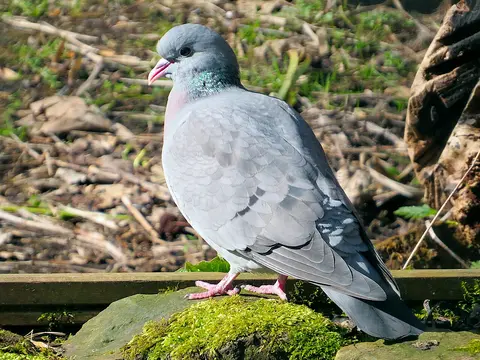
Larger and bulkier than a typical feral pigeon, with a long tail.
-
Grey overall, with a pinkish breast.
-
White patches and a green metallic sheen on the sides of the neck.
-
A broad white wing bar stands out in flight.
-
Takeoff is loud, with strong clattering wingbeats.
About the species
Mostly blue-gray, the Common Wood-Pigeon has a pinkish chest that warms its otherwise cool coloring. Adults have white patches on the sides of the neck, with a green sheen catching the light nearby, and a broad white bar across each wing that shows clearly in flight. Its pale yellow eye stands out against the gray head.
Its low, husky coo runs through a repeated five-note phrase, and takeoff can come with a loud clatter of wings. Outside the breeding season, they gather in large flocks. In towns, some grow tame enough to accept close contact from people they know.
Woodland, parks and gardens with trees all provide places to feed and nest. The diet is mostly plant matter, including seeds, grain, shoots, berries and acorns, with insects and worms sometimes added. In colder northern and eastern parts of its range it migrates, while many populations farther south and west stay year-round.
Did you know?
-
Russian forest, European park
In Russia the wood pigeon is almost entirely a forest bird and only in the last few years has begun to settle in villages by the forest, whereas in Europe, Ukraine and Belarus it calmly nests in city parks and gardens.
Link copied.
-
Almost tame
In the countryside, Wood-Pigeons are usually wary, but in cities they can become remarkably tame — sometimes even more so than feral pigeons. Birds that learn to trust particular people may even allow themselves to be stroked.
Link copied.
-
Around 200 twigs for one nest
A Wood-Pigeon nest can contain around 200 twigs while weighing only about 150 g. The bird usually gathers them nearby, carrying several at a time.
Link copied.
Where to find
-
In British city parks and gardens, listen for the repeated five-part coo from the canopy — the Common Wood-Pigeon is often heard before seen.
-
In fields, watch for ground-feeding as seeds are picked up.
-
At open water, watch for bathing and drinking.
-
On buildings in British cities, look for perches used as vantage points — with a view over the surroundings.