Pigeons and doves
Oriental Turtle Dove
Link copied.
Streptopelia orientalis
Link copied.
How to recognize it
-
About 30 cm long
-
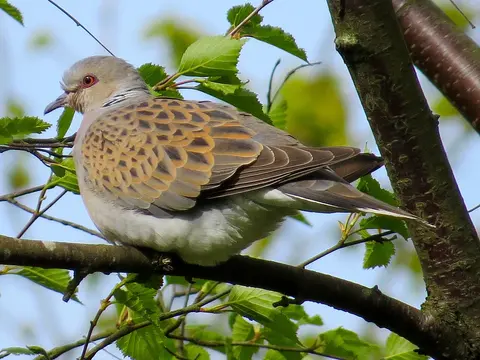
Brownish back, breast with a pinkish tinge
-
Adults: black-and-white stripes on the side of the neck
-
Calm, direct flight
About the species
Brown across the back and wings, with a pinkish wash on the breast, the Oriental Turtle Dove has a dark tail edged in white. A black-and-white striped patch marks each side of its neck, while darker centers on the wing feathers give them a lightly scaled look. Its coloring is subdued, with the neck stripes providing the sharpest contrast.
It searches the ground for food and flies with steady, direct wingbeats. Its call is a soft four-part “her-her-oo-oo.” During courtship, the male beats its wings noisily as it rises, then glides down with its tail spread.
It breeds in open woodland and uses more open places with tree cover in winter; parks and roadside plantings also offer habitat around towns. Seeds make up most of its diet, though it also eats snails. Many northern populations move south for winter, while those nearer the tropics may stay year-round.
Where to find
-
In city parks and roadside plantings, listen for the Oriental Turtle Dove's coo — it is a familiar sound in towns.
-
During the nesting season, check house cornices, attics and spaces beneath roofs for flat twig nests.
-
In sunny clearings in mixed or broadleaf woodland, look for ground feeding as the doves pick up seeds.