Falcons
Eurasian Kestrel
Link copied.
Falco tinnunculus
Link copied.
Voice
Call
Alarm
Call
How to recognize it
-
32–39 cm long
-
Adult male with a grey head and tail; female with a brown head and tail marked by dark bars
-
Hovers 10–20 m above the ground, beating the wings rapidly
-
Black stripe running from the bill corner down the cheek
About the species
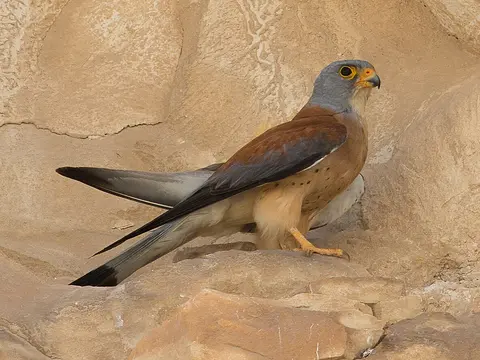
The Eurasian Kestrel’s warm chestnut back is peppered with dark spots, while its buff underside has fine dark streaks. Males have a blue-grey head and tail; females are browner, with bars across the tail. Both show a dark stripe beneath the eye and bright yellow feet.
While hunting, it can hold nearly still above a field, beating its wings as it scans below, then drop steeply onto prey. It also watches for movement from a perch. When disturbed near its nest, it gives a sharp "ti-ti-ti-ti" call; it can even spot rodent urine trails in ultraviolet light.
It hunts over open ground such as fields, heaths, marshes and scrub, and adapts to towns when food and nesting places are available. Voles and mice make up much of its diet, though it also takes large insects. In cooler parts of its range it moves south for winter; elsewhere, it usually stays put.
Where to find
-
In open patches of low vegetation among buildings, look for the Eurasian kestrel hovering about 10–20 metres above ground before dropping steeply.
-
By electricity poles or on tree branches, watch for a still silhouette scanning the ground from a perch, then dropping on prey.
-
During the breeding season, watch openings in buildings for adults arriving at their nests with prey.