Falcons
Red-footed Falcon
Link copied.
Falco vespertinus
Link copied.
How to recognize it
-
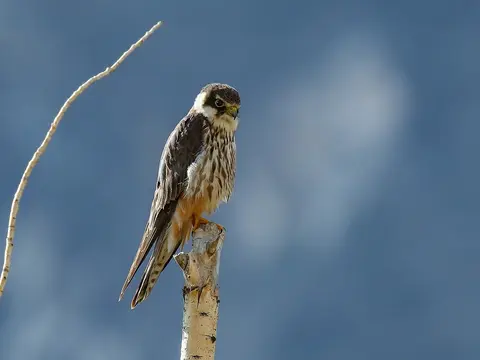
About pigeon-sized, slim build, long narrow wings
-
Adult male dark blue-grey, with brick-red belly, undertail and feathered legs
-
Adult female: ochre head and underparts, grey back and wings, black moustache marks
-
Often hovers over open ground, scanning for prey
About the species
Adult males are dark blue-grey, with red legs and a red patch beneath the tail; females have grey backs and wings, orange heads and underparts, and pale faces crossed by a dark eye stripe and moustache. In flight, a male’s underwings are evenly grey. Juveniles are brown above and buff below, with dark streaks and a face pattern like the female.
Over open ground, it hovers while searching below, then makes a short, steep dive at its target. Pairs reuse abandoned nests made by rooks, magpies and other corvids, sometimes gathering in colonies; on migration, they travel in flocks.
It breeds in open steppe and forest-steppe with scattered trees, often near water. Adults feed chiefly on large insects such as beetles, grasshoppers and dragonflies; when raising nestlings, they also bring small rodents and lizards. It leaves its Eurasian breeding grounds in August for wintering areas mainly in southern Africa, returning in May.
Where to find
-
In the steppe and forest-steppe of eastern Europe, often near water, look over open ground for a Red-footed Falcon hovering as it searches for prey, then diving steeply.
-
At woodland edges during the breeding season, scan high old corvid nests — adults may perch on nearby branches.
-
During migration in eastern Europe, watch for flocks passing overhead.