Hawks and eagles
Short-toed Snake-Eagle
Link copied.
Circaetus gallicus
Link copied.
Voice
Call
Call
Call
How to recognize it
-
Body length 59–70 cm
-
Mostly white underside, grey-brown back; pale brown throat and upper breast
-
Light barring beneath the wings; 3–4 crossbars on the tail
-
Often hovers over open country; holds wings nearly level while soaring
About the species
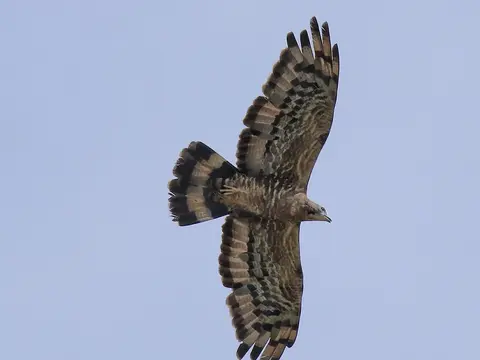
Seen in flight, its underside is mostly white, while the back and wings are grey-brown; the chin, throat and upper breast are a softer, pale brown. A rounded head and bright yellow eyes give the face a clear look, and three or four dark bars cross the tail. Light barring on the underwings shows as it circles overhead.
It spends much of its time on the wing, riding rising air over slopes and hilltops on nearly level wings. Over open ground, it may hover like a kestrel while searching for prey; snakes make up most of its food, with lizards also taken. Usually quiet, it sometimes gives clear, musical whistles.
It hunts in open farmland and grassland, as well as dry scrub and foothills, with trees nearby for nesting. European populations migrate mainly to sub-Saharan Africa, leaving in September or October and returning in April or May, while populations in the Middle and Far East stay year-round.
Where to find
-
In open cultivated plains and grasslands, look for a Short-toed Snake-Eagle hovering over the ground as it searches for prey.
-
On foothill slopes and hilltops, watch for soaring on updraughts — it hunts from these heights.
-
On remote northern breeding grounds, in forests around clearings and bogs, scan solitary trees and forest edges for a nest high above the ground.