Hawks and eagles
Greater Spotted Eagle
Link copied.
Aquila clanga
Link copied.
How to recognize it
-
Wingspan 155–180 cm
-
In flight — a dark, compact silhouette, broad long wings and a short rounded tail
-
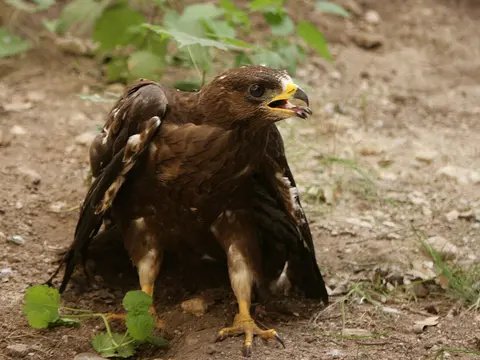
Adults — uniform dark brown plumage, yellow bill; a narrow white U above the tail, usually hidden at rest
-
Juveniles — pale drop-shaped spots, especially a clear row across the upperwing
About the species
Adults are mostly dark brown, often so dark they look nearly black, with a yellow bill and a narrow pale curve above the tail that is usually hidden when perched. In flight, their broad wings spread wide beside a short, rounded tail. Young eagles have rows of pale, drop-shaped spots across their dark wings.
Over marshes and wet fields, they glide low from a concealed perch or soar above open ground before dropping to catch prey. They sometimes search for food on foot. Their call is a high, penetrating whistle, often rendered as "kyack," and in winter they can be vocal in small, loose groups.
They nest in wooded wetlands, floodplain forests and river valleys, then migrate south for winter, with wintering grounds stretching across South Asia, Southeast Asia and the Middle East. Small mammals, especially water voles, make up much of their food, alongside waterbirds and frogs. They also take other prey and may scavenge carrion in winter.
Where to find
-
During the breeding season in floodplain woods beside marshes and wet meadows, watch the forest edge: a Greater Spotted Eagle may launch from a concealed perch and hunt over wet, open ground.
-
On migration — usually September to November and February to April — scan above lowland farmland in the Czech Republic for a lone silhouette or a pair crossing the sky.
-
In winter, at Mediterranean salt marshes and coastal lagoons with freshwater, watch for a low hunting pass over the water in search of waterbirds.