Auks · Shorebirds
Thick-billed Murre
Link copied.
Uria lomvia
Link copied.
Voice
Call
How to recognize it
-
40–48 cm long
-
Adults: black head, neck, back and wings; white underparts
-
Adults: thick, pointed bill with a white line along it
-
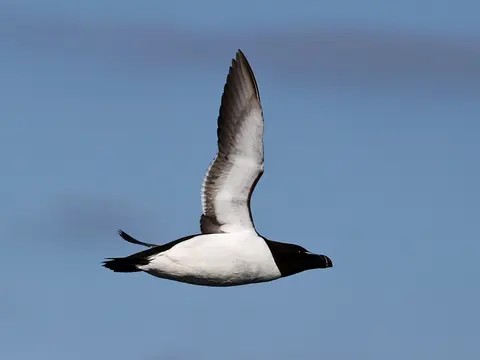
Strong, direct flight with rapid beats of short wings
About the species
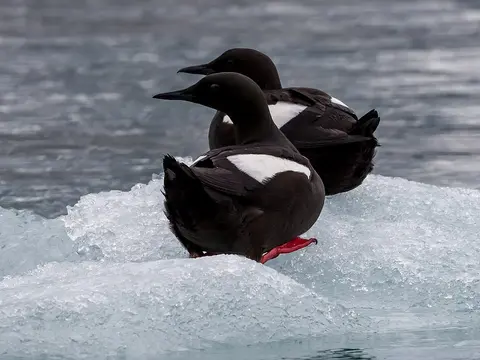
At a distance, the black head, back and wings contrast with white underparts. A long, thick bill has a narrow white stripe at the gape, and a small rounded black tail trails behind. Compared with the Common Murre, it is darker above and has a shorter, thicker bill.
At breeding cliffs, crowded colonies give harsh, cackling calls; out at sea, it is silent. It hunts with its wings underwater, taking fish and small crustaceans, and can stay submerged for up to four minutes. When young are ready to leave the ledges, they wait until night and drop toward the water, with a parent gliding close behind.
It spends almost all its life at sea in cold northern waters, coming to steep coastal cliffs only to breed on narrow ledges. Fish, especially Arctic cod, make up much of its food, with small crustaceans also on the menu. In winter, it moves south to stay in ice-free water.
Where to find
-
During the breeding season on steep Arctic and subarctic sea cliffs, look for Thick-billed Murres packed onto narrow ledges and listen for their harsh colony calls.
-
In cold northern seas, watch the surface: they dive for fish and crustaceans while feeding.
-
In winter in northern parts of the Atlantic and Pacific, scan open water farther south — they move there to avoid sea ice.