Woodpeckers
Middle Spotted Woodpecker
Link copied.
Dendrocoptes medius
Link copied.
Voice
Call
Alarm
Song
How to recognize it
-
20–22 cm long
-
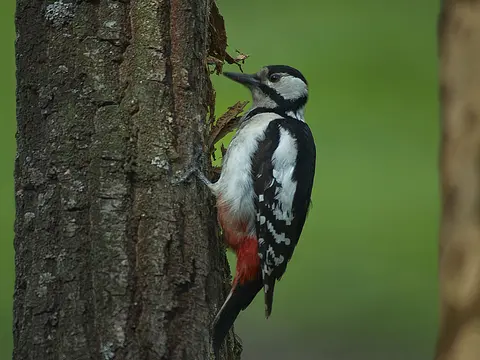
Black back, white wing patches and pink undertail
-
Adults with a red crown; rounded pale head, short slender bill; white cheeks without a black moustache stripe
-
Moves constantly in the treetops, drums rarely; nasal "gvayk-gvayk"
About the species
Black above and pale beneath, the Middle Spotted Woodpecker has a bright red cap that can rise into a small crest. White patches break up its dark wings, while its vent is pink and its flanks carry fine dark streaks. Its face looks open, without the bold black moustache stripe seen on many other woodpeckers.
It keeps moving through the upper branches, picking insects and larvae from twigs rather than chiselling beneath the bark. Drumming is rare; in late winter and spring, its slow, nasal song sounds like "gvayk gvayk gvayk", with a quicker "kik kekekekek" call at other times.
Old deciduous woods, especially those with oak, hornbeam or elm, are its main home, though it also uses old parks and orchards near woodland. It feeds chiefly on insects and their larvae, takes tree sap too, and may eat nuts and seeds in winter. Mostly resident, it makes local movements outside the breeding season, including shifts up and down mountain slopes.
Where to find
-
In old, abandoned parks and apple or pear orchards at the edge of deciduous woodland — a pattern noted in Germany, Austria and Switzerland — look high in the crowns for a Middle Spotted Woodpecker moving quickly along branches as it searches for insects.
-
In mature oak-hornbeam woodland, watch the thin branches: it picks exposed insects from them and sometimes hangs from their tips.
-
At the end of winter and in spring, listen in deciduous woodland for a slow, nasal, raspy song — drumming is much less likely.
-
During breeding season, look near a woodland clearing or edge at decaying trunks and thick branches: a nest hole may be low, with adults arriving to feed the chicks.