Swifts
Pacific Swift
Link copied.
Apus pacificus
Link copied.
How to recognize it
-
Body length 17–18 cm
-
Broad white rump band, deeply forked tail
-
Black underparts with pale feather edges, scaly-looking from below
-
Harsh screech, a drawn-out "spee-eer"
About the species
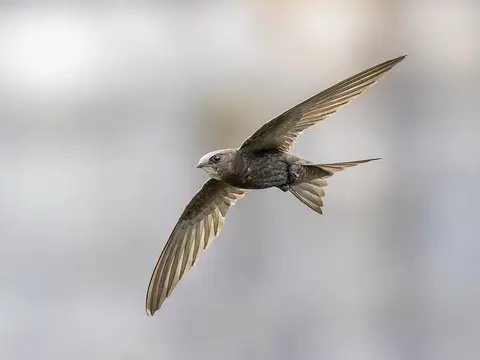
Against its blackish body, the Pacific Swift has a greyer head and a white band across its rump. A white throat patch stands out above a dark belly patterned with pale feather edges, giving it a fine, scaly look from below. Its long, pointed wings and deeply forked tail are clear as it banks overhead.
Near breeding sites, flocks give a trilled "tsiririri" or a harsher "spee-eer." It spends most of its time in flight, often circling high above the ground in groups around insect swarms. In bad weather, chicks can go days without a meal, using stored body fat.
It breeds across eastern Asia, nesting in sheltered places such as caves, rock crevices and under house eaves. It catches bees, moths, flies and other insects in flight, over towns, coasts and open country. Strongly migratory, it spends the northern winter in Southeast Asia and Australia.
Where to find
-
In East Asian towns during the breeding season, look beneath house eaves for Pacific Swift nests attached to vertical surfaces.
-
By caves and sheer cliffs within the breeding range, listen for calling flocks and watch them pass nearby.
-
In Australian towns during the wintering season, scan high above rooftops for flocks circling as they catch insects in the air.
-
Along migration routes on the coasts of Malaysia, Sumatra and Java, watch for passing flocks; in Europe, it is only a rare vagrant.