Flycatchers and chats · Perching birds
Red-breasted Flycatcher
Link copied.
Ficedula parva
Link copied.
Voice
Call
Song
Song
How to recognize it
-
Length 11–12 cm
-
Adult breeding male with an orange throat; females and juveniles lack the orange patch
-
White eye-ring; black tail with white bases to the outer feathers
-
Often flicks and fans the tail
About the species
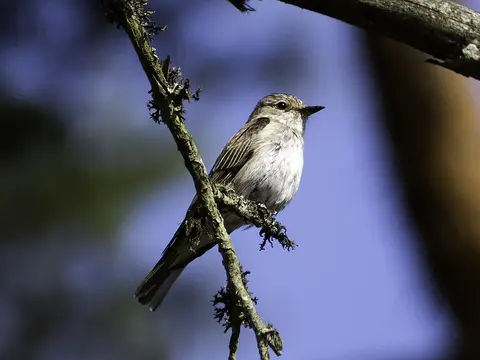
A breeding male is muted brown above and pale below, with a grey head and an orange throat; females and young lack the bright throat patch. A white ring circles the eye, and the dark tail has white at the base of its outer feathers. The colors are subdued overall, making the eye ring and the male’s throat the clearest details.
From a perch among the branches, it watches for insects, flicking its tail upward before darting out to catch them, sometimes hovering briefly. Males sing a run of clear whistles, often after a quiet “zit” or “tsi-it”; they may display their throat and partly open their wings, but stop singing once they find a mate.
It breeds in mature broadleaf and mixed forests, and also occurs in parks, old orchards and vineyards. Insects and small spiders make up most of its food, with berries added in autumn; it migrates to South Asia for winter, passing through western Europe on its way.
Where to find
-
In mature broadleaf or mixed woods during the breeding season, scan the canopy for brief insect-catching sallies, often followed by a tail flick from a lookout perch.
-
At forest clearings and near water, watch the shrubs for brief hovering flights as insects are picked from the foliage.
-
In mature woods during the breeding season, listen for males singing from bare or dead branches at mid-height; the song lasts only a few weeks and stops once a mate is found.
-
In autumn, look around elderberry, currant, and blackberry bushes for feeding on berries, which supplement the Red-breasted Flycatcher's diet then.