Hawks and eagles
Rough-legged Hawk
Link copied.
Buteo lagopus
Link copied.
How to recognize it
-
Body length 45–63 cm
-
Long wings; regularly hovers over open ground
-
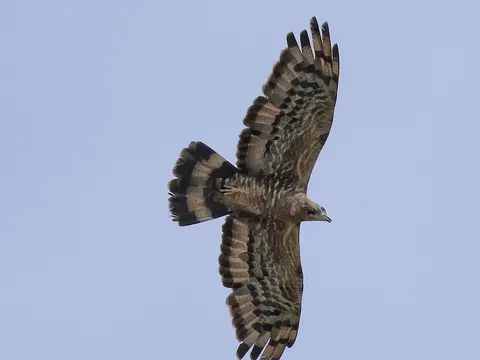
Light morph: pale underwings, black patch at the bend; white tail with a dark band near the tip
About the species
Most have brown-and-white plumage, though some are much darker. A broad brown band crosses the chest, and in lighter plumage a black patch marks each wrist against the pale underside of the wings. The white tail carries a dark band near its tip, while feathers cover the legs almost to the toes.
While searching open ground, it may hover in one spot with quick wingbeats, then drop toward prey. It also watches from a perch before swooping. Near a nest, adults give a long, falling alarm whistle — "kee-eer" — from a perch or in flight, and may repeat it every 15–30 seconds.
It breeds across Arctic and subarctic tundra and taiga, then moves south for winter, using open marshes, moorland, prairies and farmland. Voles and lemmings make up most of its food, though it takes other small mammals and, when rodents are scarce, may turn to prey such as ptarmigan.
Where to find
-
From October to April, scan open marshes for a Rough-legged Hawk hovering above the ground in search of small mammals.
-
On winter farmland, watch for a pause on a perch followed by a sudden stoop at prey.
-
In northern tundra during the breeding season, keep well away from nests and listen for a descending alarm whistle from a perch or in flight.