Flycatchers and chats · Perching birds
Whinchat
Link copied.
Saxicola rubetra
Link copied.
Voice
Song
Song
Song
How to recognize it
-
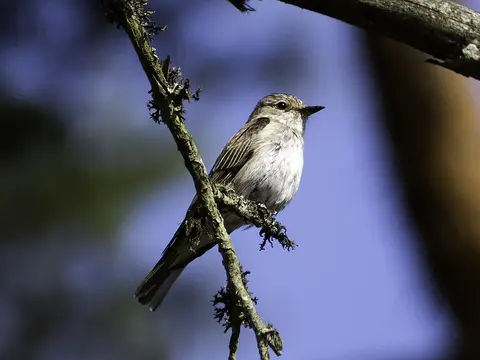
12–14 cm long; short tail, brown upperparts mottled darker
-
Pale stripe over the eye, whitish belly
-
Often perches on shrubs and posts, flicking tail and wings
-
Call "hue-tac-tac"
About the species
Brown upperparts are mottled with darker marks, above a pale throat and breast and a whitish belly. A clear pale stripe over each eye gives the face a bright line, while white at the base of the outer tail feathers shows when the tail flicks. In breeding season, the male’s throat and breast turn orange-buff, and small white patches show on his wings.
On the ground, it moves in quick hops, often bobbing and flicking its wings and tail. From a fence post, shrub or tall weed, it scans for insects, then darts down to snatch them from the ground or air. Its call is a brisk "hue-tac-tac"; the male’s breeding song mixes soft, crackly whistles with harsher notes and may include phrases copied from other species.
Rough grassland with scattered shrubs suits it, including pasture, heath and other open ground; it needs a few high perches among the low growth. It feeds mostly on insects, with spiders, small snails and worms also on the menu, and takes a little fruit in autumn. After breeding in Europe and western Asia, it migrates south to sub-Saharan Africa for winter and returns in spring.
Where to find
-
Beyond the city, on flood meadows, pastures and marshes, look for the Whinchat making quick hops across the ground and bobbing its tail.
-
On open, lightly managed grassland with scattered shrubs, watch for short flights from a bush or fence post as it catches insects — most often from the ground.
-
In breeding areas from April to July, listen for a male's soft, whistling song from a bush, tree or fence post amid open grassland.