Reed warblers · Perching birds
Blyth's Reed Warbler
Link copied.
Acrocephalus dumetorum
Link copied.
Voice
Song
Song
Song
How to recognize it
-
12–14 cm long
-
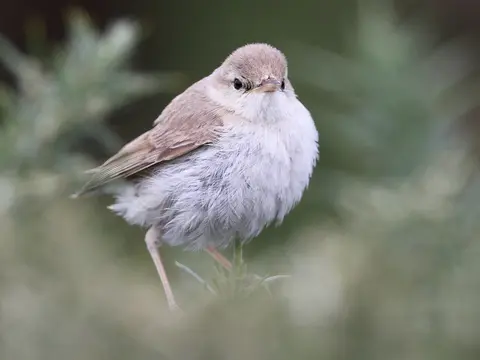
Plain olive-brown upperparts, pale underside
-
Short whitish eyebrow and dusky stripe through the eye
-
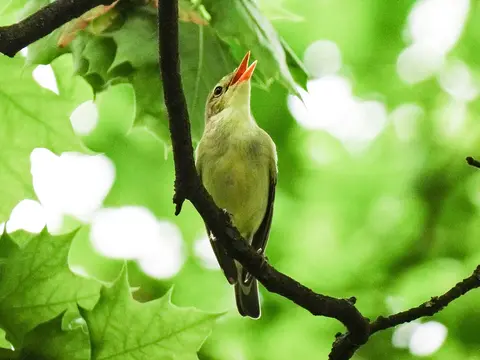
Song mixing harsh "tick", "chak" and "churr" sounds with whistles and mimicry
About the species
Olive-brown above and pale underneath, Blyth's Reed Warbler has muted coloring and few strong markings. A short whitish stripe above the eye sits over a dusky line through it, while the long, fairly thick bill has a pale base. Its short, rounded wings are less olive than its back.
It keeps to itself and holds a territory. Its variable song mixes clipped “tick,” “chak,” and “churr” notes with clear whistles and snippets of mimicry; it may imitate other calls at night, too.
During the breeding season, it uses the edges and clearings of damp broadleaf woods, along with wooded gullies, scrub, parks, and gardens. It feeds on insects and winters in South Asia, from India and Sri Lanka to Nepal, Bangladesh, and Myanmar, where it uses trees in both wet and dry habitats.
Where to find
-
During the breeding season in city parks and gardens, listen for a varied song mixing sharp "ticks" and "chaks" with melodic whistles.
-
At a damp broadleaf woodland edge or clearing, listen at night for a song that may imitate other calls.
-
By a river, stay on the path beside scrub and dense perennial herbs: the cup nest is tucked just 20–60 cm above the ground.