Reed warblers · Perching birds
Icterine Warbler
Link copied.
Hippolais icterina
Link copied.
Voice
Song
Song
Call
How to recognize it
-
Body length 12–13.5 cm
-
Greyish-green upperparts, uniformly pale-yellow underparts
-
Pale feather edges form a panel on the folded wing; short, square-ended tail
-
Fast, nasal song imitating calls of other species
About the species
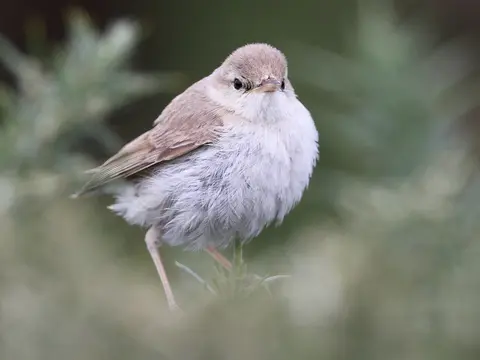
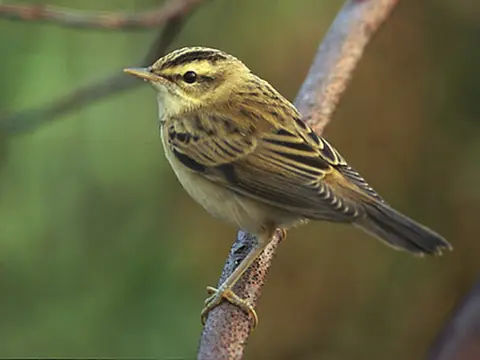
Olive-green above and pale yellow below, the Icterine Warbler has a faint yellow eyebrow and a pale ring around each eye. Pale edges on its folded wing feathers make a light panel, while its long wings extend beyond a short, square-ended tail. Its legs are grey, sometimes with a bluish cast.
It works through leafy branches, picking insects from leaves and fluttering out to catch them in the air. Its song is a quick, nasal babble threaded with imitations of other species; a short “teck” is its call. It tends to keep apart from others of its kind and holds a territory on both breeding and wintering grounds.
Open woodland suits it best, especially edges and clearings with spaced trees and tall shrubs below; parks, gardens, orchards and tall hedges among trees also provide the mix it uses. It feeds mainly on insects, adds fruit in late summer, and migrates to sub-Saharan Africa for winter, returning to its European breeding grounds in late May.
Did you know?
-
Jaundice cure
Pliny claimed in his Natural History that a single glimpse of an Icterine Warbler was enough to cure a person of jaundice. The bird's name traces to the Greek ikteros, meaning either a greenish-yellow bird or the disease itself.
Link copied.
-
All winter south of the equator
The Icterine Warbler is one of only two Palaearctic passerines whose entire population winters south of the equator — the other is the Lesser Grey Shrike.
Link copied.
-
Top mimics of central Russia
In central Russia the Icterine Warbler ranks among the strongest avian mimics, alongside Marsh and Garden Warblers, Red-backed Shrike and Starling.
Link copied.
Where to find
-
In city parks during the breeding season, look into the canopy for the Icterine Warbler gleaning insects from leaves and fluttering near twig tips.
-
In orchards in late summer and autumn, watch for movement among the branches as fruit joins the diet.
-
In central Russia in late June, listen for low, hoarse calls from fledglings in shrubby undergrowth along woodland edges.