Rails and coots · Cranes and rails
Corn Crake
Link copied.
Crex crex
Link copied.
Voice
Song
Song
Song
How to recognize it
-
27–30 cm long
-
In breeding season, male with blue-grey breast and neck; female with warm ochre tones in these areas
-
On take-off, weak fluttering flight with legs dangling
-
Male's repetitive grating call in the breeding season: "krek-krek", audible up to 1.5 km
About the species
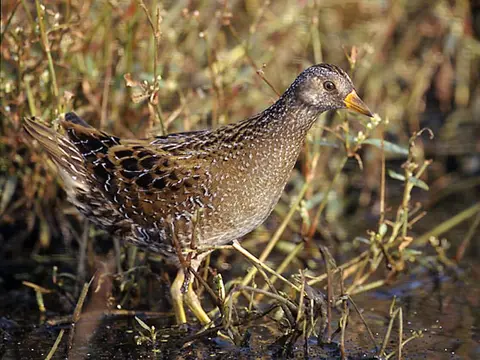
Mostly hidden in tall grass, the Corn Crake is easier to picture from a brief glimpse: its upperparts are brown, streaked with buff, while a breeding male has a blue-grey face, neck and breast. Chestnut patches warm the wings, and the sides are barred with chestnut and white. Females are browner below, with less grey.
A male’s loud, rasping "krek krek" carries across fields, often repeated through the night in the breeding season. He calls from within the vegetation; when disturbed, the crake usually runs quickly through the grass and may take a short, fluttering flight before dropping back into cover.
It breeds in moist, tall grassland, especially hay meadows, and may also nest in crops such as cereals, peas or clover. It searches the ground and low plants for insects, worms, slugs and other small prey, adding grass seeds and grain. After breeding, it migrates at night to grasslands and savannas in Africa, returning to Eurasia in spring.
Did you know?
-
Rasp carries past a mile
The corncrake's rasp carries more than 1.6 km — for rivals it says "stay away," for females, "come closer."
Link copied.
-
Feeds chicks bite by bite from the bill
For the first few days, corncrake parents keep prey in the bill — holding a caterpillar or spider while the chicks peck it apart bit by bit.
Link copied.
-
Heard, never seen
Barely larger than a thrush, the corncrake slips through an entire breeding season without being seen — only its voice gives it away.
Link copied.
Where to find
-
In May and the first half of summer, listen beside damp hay meadows in the evening and at night for a rasping "krek-krek" from a low perch near a bush — the Corn Crake usually stays hidden in tall grass.
-
At the edge of a hay or cereal field beside fallow ground, watch for quick runs through the grass: food is sought on the ground and among low plants.
-
After breeding, in July and August, look towards stands of reed, iris or nettles: adults move there to moult and grow quiet.