Grebes
Eared Grebe
Link copied.
Podiceps nigricollis
Link copied.
How to recognize it
-
Body length 28–34 cm
-
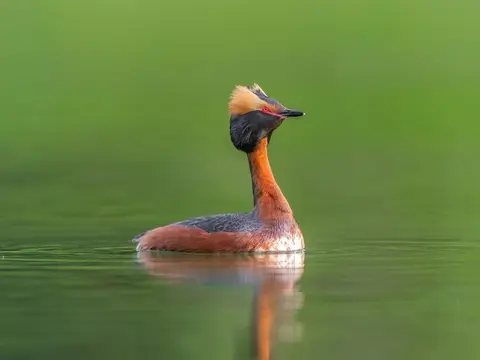
In spring and summer, black head and neck, golden feather tufts behind the eyes
-
In winter, grey cap extending below the eyes, grey front of neck, slightly upturned dark-grey bill
-
On water, holds neck upright; when alarmed, dives rather than taking flight
About the species
In breeding season, its head and neck are black, with golden feathers fanning back from each eye. Chestnut sides contrast with the dark upper body, while the belly stays white and the eye is bright red. Outside breeding season, the gold and chestnut give way to a greyer head and sides, with white showing across much of the underside.
It spends most of its time on the water, holding its neck upright as it swims, and slips underwater when danger approaches rather than taking off. During breeding season, it gives a high, rising "ooeek" and a quick trill; at other times it is usually quiet. Newly hatched chicks can swim and dive, but often ride on a parent's back.
It breeds on vegetated freshwater lakes, often in colonies, then travels to saline lakes to moult before continuing to wintering grounds. Insects make up most of its diet, alongside crustaceans and other small aquatic prey; at salt lakes rich in brine shrimp, those become its main food. In the north, it migrates; in parts of Africa, it also winters where it breeds.
Where to find
-
On quiet freshwater lakes with aquatic plants, look for the Eared Grebe diving for aquatic invertebrates.
-
During the breeding season, scan shallow open lakes for floating nests anchored among plants; for their first few days, chicks may ride on their parents' backs.
-
At very salty lakes during the moult, look for large gatherings feeding mainly on brine shrimp.