Grebes
Great Crested Grebe
Link copied.
Podiceps cristatus
Link copied.
Voice
Call
How to recognize it
-
Body length 46–51 cm
-
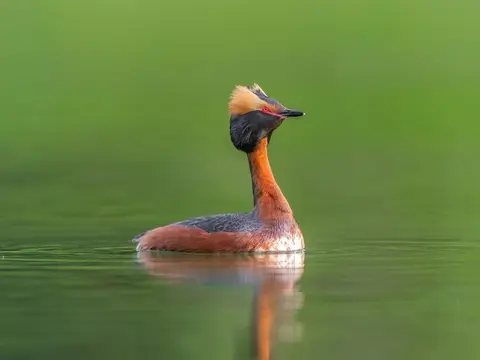
In spring — two dark head tufts and a rusty-orange ruff
-
Brownish-red back, white head and belly
-
Stays on the water, often diving for fish
About the species
In breeding plumage, a white face and underside contrast with a dark, rusty-brown back. Two dark feather tufts rise from the crown, while an orange-brown ruff frames the cheeks and neck; the long, straight bill points forward. The head decorations disappear in winter, leaving a plainer, whiter look.
Most of its time is spent on the water, where it dives after fish and is reluctant to fly. Its call is a loud, barking "rah-rah-rah"; courting pairs face one another, shake their heads, then rise upright with weeds in their bills. Adults carry chicks on their backs and dive, leaving the young to swim back to them.
It breeds on vegetated freshwater lakes and winters on lakes, reservoirs or the coast. Fish make up most of its diet, with insects, small crustaceans, frogs and newts also on the menu. Populations in colder parts of the range migrate, while those in milder areas stay year-round.
Where to find
-
At quiet ponds and lakes, watch for the Great Crested Grebe on the water, diving for fish.
-
At a vegetated freshwater lake during breeding, listen for loud calls and watch a pair approach each other on the water.
-
At the edge of a quiet lake during breeding, look for a floating nest made of dead vegetation, mainly reeds.