Sandpipers · Shorebirds
Eurasian Curlew
Link copied.
Numenius arquata
Link copied.
Voice
Call
Song
Call
How to recognize it
-
50–60 cm long
-
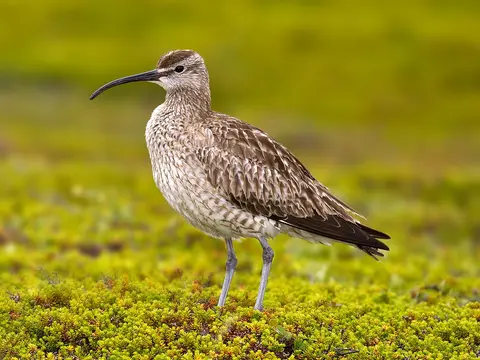
Very long bill, smoothly curved downward
-
Grey-brown plumage with streaks; white back visible in flight
-
Loud, drawn-out call, "curloo-oo"
About the species
Across open ground, its plumage is grey-brown and finely streaked, with a clear white back. The long bill curves down in a smooth arc, and grey-blue legs show beneath it. Females usually have a longer bill than males, though the sexes otherwise look much alike.
It is wary, but outside the breeding season it gathers in groups. Its loud, drawn-out call sounds like "curloo-oo"; during breeding, males sing to mark their nesting territories.
It nests in marshes and other wet places, laying four eggs in a shallow scrape in a meadow. It probes soft mud for small invertebrates and also takes earthworms and small crabs from the surface. Most populations move south for winter, reaching Africa, southern Europe and southern Asia, while it stays year-round in milder parts of Ireland and the UK.
Where to find
-
During the breeding season, on marshy meadows outside the city, listen for the Eurasian Curlew's drawn-out "curloo-oo" call — males use it to mark nesting territories.
-
In winter, along muddy coasts, watch a long bill probe soft mud for small invertebrates.
-
In winter, on inland flooded meadows, watch a long bill pick worms and molluscs from the ground.