Sandpipers · Shorebirds
Eurasian Whimbrel
Link copied.
Numenius phaeopus
Link copied.
Voice
Call
Call
Call
How to recognize it
-
Body length 40–46 cm
-
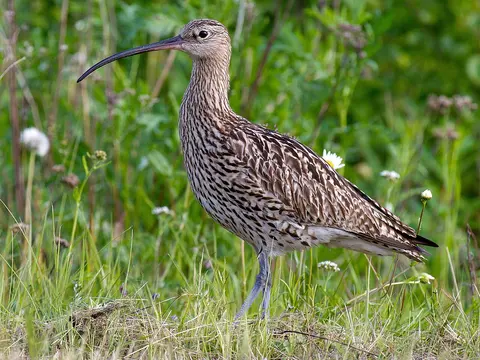
Dark crown with a pale stripe down the middle and pale eyebrows
-
Bill shorter than the Eurasian curlew’s, curving down
-
Grey plumage mottled all over; trilling call
About the species
Grey-brown plumage is streaked across the body, with a dark crown divided by a pale stripe and pale eyebrows above the eyes. Its long bill curves down at the tip, and its legs are bluish grey. Some populations show a white rump in flight, a bright patch against the muted coloring.
A rippling whistle can lengthen into a trill. On the breeding grounds, an adult may stay motionless until danger comes close, then fly a short way off and call to draw it away from the nest. The chicks soon become mobile on the ground, and the nest is abandoned.
It breeds on northern tundra and moorland, and also uses wet, low-lying grasslands near water. It probes soft mud for small invertebrates and picks crabs from the surface; berries become important before migration. Outside the breeding season it gathers along coasts, wintering in Africa, South Asia and Australasia.
Where to find
-
On marshy lake shores, the Eurasian Whimbrel probes soft mud for small invertebrates.
-
On coastal mudflats during migration and winter, watch it pick small crabs from the surface.
-
Before migration in northern bogs, look for it feeding on berries.