Thrushes · Perching birds
Fieldfare
Link copied.
Turdus pilaris
Link copied.
Voice
Song
Call
Call
How to recognize it
-
25 cm long
-
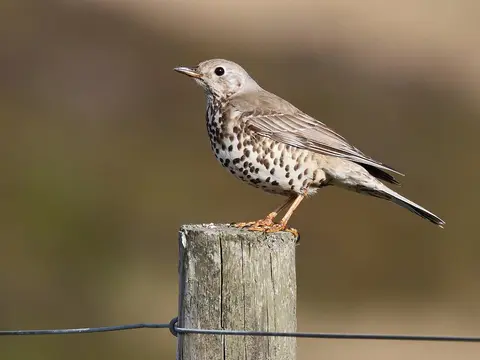
Grey head, neck and rump against a brown back
-
Reddish-washed breast with bold dark spots
-
White underwings show in flight; harsh "tsak-tsak" call
About the species
The fieldfare's slate-grey head, neck and rump contrast with its brown back and dark tail. A rusty wash warms the pale breast, with bold spots continuing down the flanks. The undersides of the wings flash white in flight. Females are a little browner than males, though the two look much alike.
They gather in flocks, feeding on the ground and pausing upright to look around before moving on. A rough "tsak tsak" carries in flight, while in trees the call softens into a steady chatter. They are easily startled in winter, but become noisy and bold around breeding sites.
They breed in woodland and scrub, often near open ground, and also visit orchards, parks and gardens. In warmer months they eat insects, worms and snails, turning to berries, fallen apples, grain and seeds as the seasons change. Many from the north move south for winter, reaching southern Europe and North Africa.
Did you know?
-
Faeces-bombing the magpie
When a magpie approaches a fieldfare colony, the birds mob it in coordinated dives, releasing precisely aimed feces that can plaster the predator so thoroughly it tumbles to the ground.
Link copied.
-
Irregular migrants
Fieldfares irrupt unpredictably across Europe every few winters: a warm breeding season boosts both their numbers and the berry crop, but the following autumn the crop fails and the swollen population must move in search of food.
Link copied.
-
Hundred-metre blackbird exclusion zone
A lone fieldfare wintering in a suburban garden systematically expelled every blackbird from its food supply, enforcing an exclusion zone extending a hundred metres in all directions.
Link copied.
Where to find
-
In park plantings, listen for fieldfares chattering softly in the trees.
-
In summer, at a woodland edge beside a damp meadow, watch groups feed on the ground, pausing now and then to stand upright and look around.
-
Late in winter in orchards, watch for windfall apples being pecked up from the ground.