Sylviid warblers · Perching birds
Greater Whitethroat
Link copied.
Sylvia communis
Link copied.
Voice
Song
Call
Song
How to recognize it
-
Smaller than a sparrow
-
Adult male with a grey head and white throat; female lacks the grey head, throat duller
-
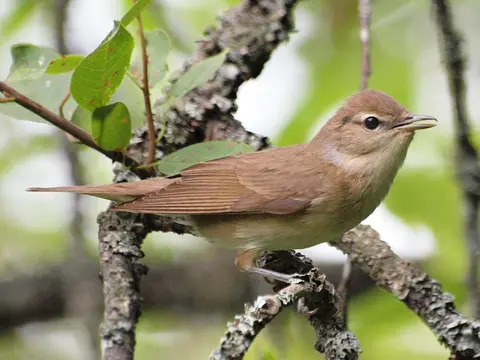
Grey-brown upperparts, pale underparts, chestnut edges to the wing feathers
-
Hoarse, nasal call, "wed-wed"
About the species
Moving through a hedge, it shows a warm brown back and buff underside, with chestnut edging on the wing feathers. Adult males have a grey head and white throat; females are browner-headed, with a duller throat. The rusty feather edges give the folded wing a fine, warm border.
It threads through low shrubs and often springs into the air to sing. The song comes as a fast, scratchy chatter with a scolding edge, while its hoarse, nasal call sounds like "wed-wed." A longer, rough "tschehr" serves as a warning.
Across Europe and much of temperate western Asia, it breeds in open country and cultivated areas where low bushes or brambles offer cover and nesting sites. Insects make up most of its food, though it also eats berries and other soft fruit. It migrates south for winter, reaching tropical Africa, Arabia and parts of South Asia.
Where to find
-
Along field boundaries among cultivated fields, listen for the Greater Whitethroat's fast, scratchy song among the bushes.
-
At a forest edge or clear-cut, watch for a sudden lift into the air during song — it often rises while singing.
-
Among sparse shrubs in a ravine or wormwood thickets, listen for the loud, nasal, hoarse "wed-wed-wed" call.