Leaf warblers · Perching birds
Green Warbler
Link copied.
Phylloscopus nitidus
Link copied.
Voice
Song
How to recognize it
-
Body length 10–11 cm
-
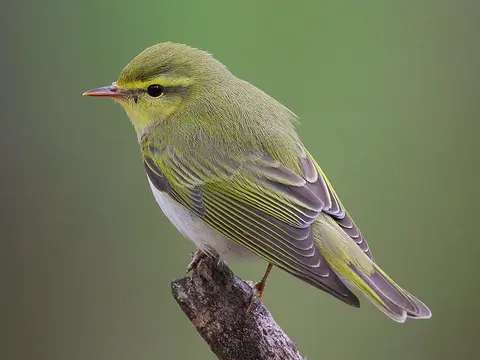
Green upperparts, lemon-yellow sides of the head and underparts
-
One clear yellow wing bar, a second short and faint one, especially in juveniles
About the species
The green warbler wears brighter yellow-green plumage than its close relatives. The upperparts are greener, while the face and underparts carry a clear lemon-yellow wash, and the wing shows a thin pale bar with a second shorter one behind it.
It moves through the canopy with quick, careful motions and gives a sharp two-part call, “tchivri, tchivri.” Its song and calls are close to those of the greenish warbler, so the voice is often the easiest clue.
It nests in mountain broadleaf and mixed woods, and also in shrub belts above the tree line. It feeds on small insects and larvae, breeds in the Caucasus and nearby regions, and winters in southern West Asia.
Where to find
-
In mature city parks with tall old broadleaf trees, it stays high in the canopy — listen for the sharp two-note call.
-
Along quiet park edges and shrub thickets, especially where branches hang low, it flickers through the leaves while feeding.
-
On old stone bridges, retaining walls, and masonry embankments, it may check cracks and cavities — a brief flash near the stones.
-
In hilly neighborhoods with scattered trees, it is more often heard from the upper branches than clearly seen.