Leaf warblers · Perching birds
Yellow-browed Warbler
Link copied.
Phylloscopus inornatus
Link copied.
Voice
Call
Call
Call
How to recognize it
-
Smaller than a sparrow
-
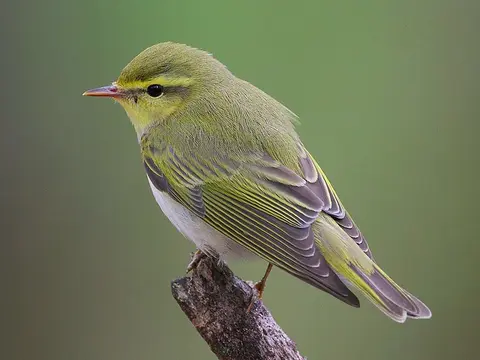
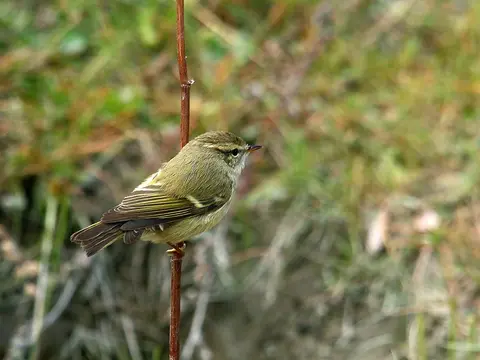
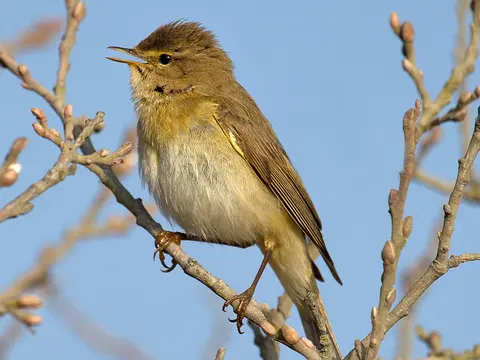
Olive-green upperparts, yellowish-white underparts
-
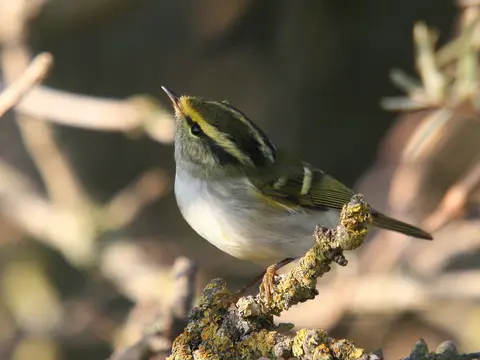
Long yellow eyebrow and two pale bars on each wing
-
Almost constantly in motion
About the species
Olive-green above and pale yellowish white below, the Yellow-browed Warbler has a long yellow stripe over each eye that reaches toward the back of its head. Two pale bars cross each wing, with fine yellow edges on some feathers. Its green back and light underside show clearly as it moves among the leaves.
It is not especially shy, but keeps almost constantly in motion through tree foliage, so it can be hard to follow. Its song is a high-pitched run of whistles, and its piercing call is often a two-part “tseeweest”—loud for its small size.
It uses lowland and mountain forests and woodland, including more open woods in winter, and feeds on insects. After breeding across northern Asia, it migrates south to spend winter mainly in tropical South and Southeast Asia; small numbers also winter in western Europe.
Where to find
-
From May to October in Russia, listen in sparse coniferous or mixed woodland for a short song with a buzzing finish — the Yellow-browed Warbler sings among the branches.
-
In gardens and groves within its range, scan the foliage for near-constant movement as it picks insects.
-
In western Europe, an autumn or winter encounter is rare; in woodland, listen for the piercing, two-syllable call.