Hawks and eagles
Long-legged Buzzard
Link copied.
Buteo rufinus
Link copied.
How to recognize it
-
Body length 57–65 cm
-
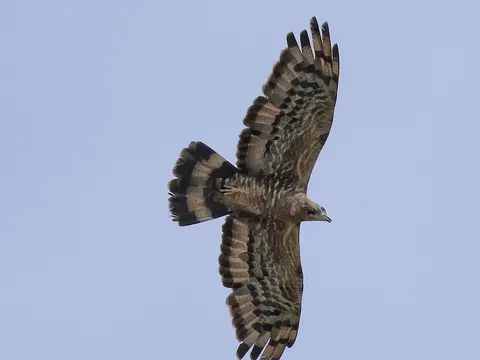
Long, broad wings and a long, rounded tail
-
Pale morph: pale head and breast, rufous-brown belly
-
Slow, deep wingbeats; often hovers for long periods
About the species
In its pale form, the Long-legged Buzzard has a sandy, lightly streaked head and chest above a darker brown back and wings. A warm rufous belly and tail add color, and the tail can look almost white from below at a distance. Plumage varies widely, from pale tones through rich rusty shades to very dark brown.
It spends long stretches watching the ground from a rock, pole, or mound, then drops onto prey; at times it hangs in the air before diving. It may also walk slowly over the ground, and its voice is heard less often than the Common Buzzard’s—a brief, slightly higher “mew.”
Open steppe, semi-desert, dry scrub, and rocky slopes suit it, though it also hunts over farmland and can nest on cliffs, trees, or raised structures. Small mammals make up much of its food, with lizards and other reptiles, insects, other prey, and carrion also taken. Populations in the north and east generally move south for winter, while those farther south are often resident.
Where to find
-
In small towns, occasionally watch for a long-legged buzzard using old buildings as cover, then darting up to catch pigeons as they rise from ledges or eaves.
-
Along open steppe edges or dry pastures, scan poles and wires for a still silhouette watching the ground for prey.
-
Above dry rocky slopes, watch for broad circles over open ground — sometimes it hangs in place before a steep drop toward prey.